Education is one of PHWO’s core areas of work. A student who cannot pay a school, college, university or examination fee can already ask for help through Request Help — fees are paid directly to the institution against its own challan. The wider programme below opens in stages across Pakistan.
Education and Literacy
Under Aim 1 of our constitution, PHWO will promote education and literacy by supporting deserving students, educational institutions and learning opportunities, particularly for underprivileged communities.
The Need
Pakistan has one of the largest out-of-school populations in the world, and government surveys and national education statistics consistently show that districts in interior Sindh trail national averages on enrolment, retention and female literacy. The reasons families give are rarely about valuing education less. They are about cost, distance, the loss of a child’s earnings, and schools that are too far or unsafe for girls to reach. The Sindh Education Department publishes provincial school and enrolment information for readers who want the district picture in detail.
The cruel detail is how small the deciding amounts often are. A term’s fee, an examination form, a uniform or a set of books can be the difference between a child continuing and a child leaving. Once a child leaves, they very rarely return. Most districts have schools, colleges and teachers; what is often missing is the small, timely support that keeps a student inside the system long enough to finish.
What PHWO Does
- Support deserving students. Assistance with school and college fees, examination costs, books, stationery, uniforms and bags, targeted at students at genuine risk of dropping out.
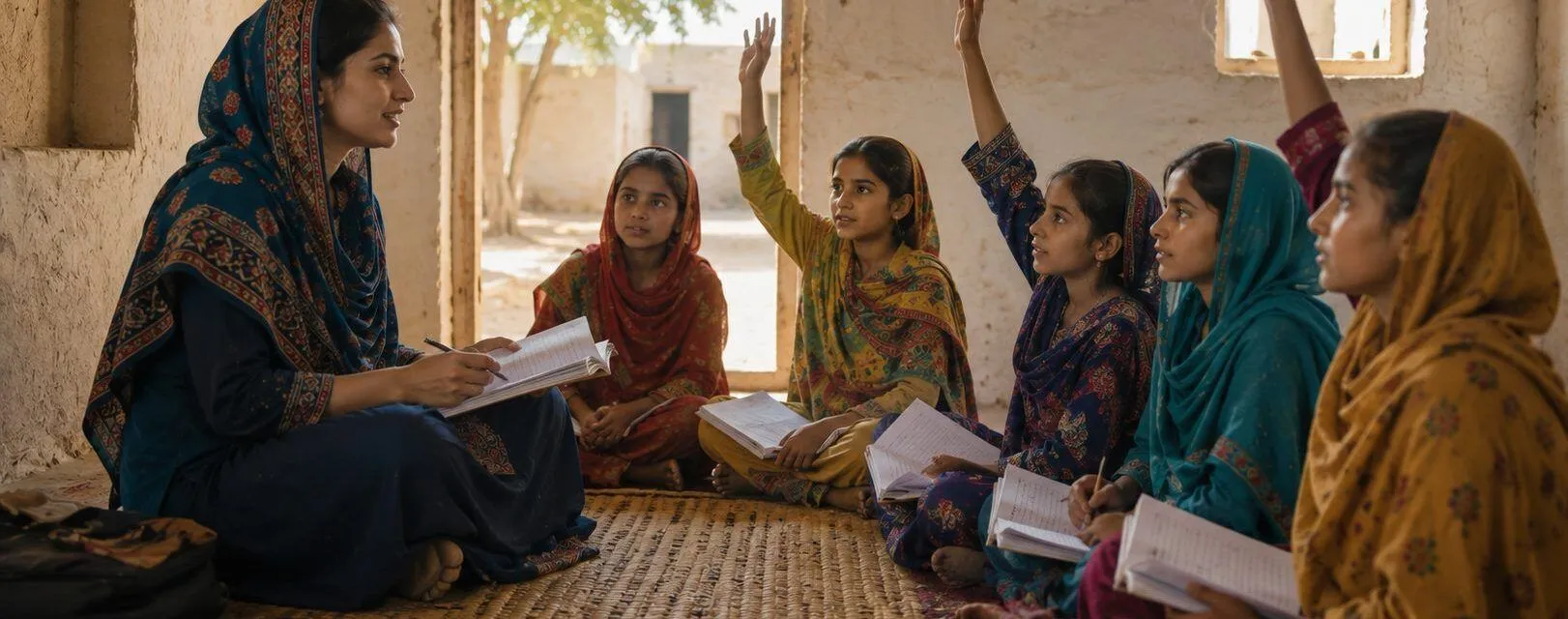
- Prioritise girls’ continuation. Dedicated support for girls at the transition points where dropout is highest, particularly the move from primary to middle and from middle to matriculation.
- Strengthen existing institutions. Work with schools and learning centres already operating in the areas we serve, supplying teaching materials, learning aids and volunteer teaching support rather than duplicating what exists.
- Run supplementary learning. After-school and holiday coaching in the subjects where students most often fail, delivered by volunteer teachers and senior students.
- Deliver adult and female literacy sessions. Short, practical literacy and numeracy courses for adults, with women-only classes taught by women.
- Support re-entry. Identify out-of-school children in target neighbourhoods and work with families and schools to get them admitted. UNICEF Pakistan sets out why children leave school and what tends to bring them back.
- University, college and examination fees. Help with semester fees, board and admission fees and examination forms for students who would otherwise lose their place — paid to the university, board or college directly.
- Devices for study. Laptops and smartphones for students who cannot follow online classes, submit assignments or sit online tests without one.
- Scholarships and mentoring. Linking capable students with sponsors, and with professionals who guide them through admissions, subject choices and careers.
- Children with disabilities. Accessible materials, assistive devices and support so that a disability is not the reason a child leaves school.
Who It Serves
Students from low-income households across Pakistan, with priority given to girls, orphans, children of daily-wage workers and families facing a sudden shock such as illness, bereavement or displacement. Selection will be made against written criteria, with applications verified by our volunteers and, where appropriate, confirmed with the student’s school. Selection is made on need alone: PHWO is non-political and non-sectarian, and no applicant is preferred or refused for their faith, sect, ethnicity, gender or affiliation.
How It Is Measured
We report against these indicators honestly, including where we fall short, on the terms set out in our transparency commitments. Those indicators are:
- number of students supported, disaggregated by gender and school stage;
- retention: the proportion of supported students still enrolled at the end of the academic year;
- progression: the proportion who pass their year or examination;
- attendance and completion rates in supplementary and literacy classes;
- cost per student retained, so donors can see what their money achieves;
- a follow-up check with families to confirm that support reached the child and not simply the ledger.
Results are published once they are verified, in our annual activity and financial reporting.
How You Can Support It
- Fund a student. Sponsor a term or a year of fees, books and uniform for one child, restricted to this programme so that one hundred per cent of your gift reaches it.
- Give in kind. Books, stationery, school bags and teaching materials are all usable immediately.
- Teach. Volunteer teachers, graduates and senior students are needed for supplementary and literacy classes. Apply through our Volunteer page.
- Partner. Schools, colleges and CSR teams can fund or host a cohort. See Partner With Us.
To discuss supporting this programme, write to info@phwo.org.
Help us start this work
This begins when the people and the funding are there
Last reviewed . Published by Peace and Humanity Welfare Organization.