
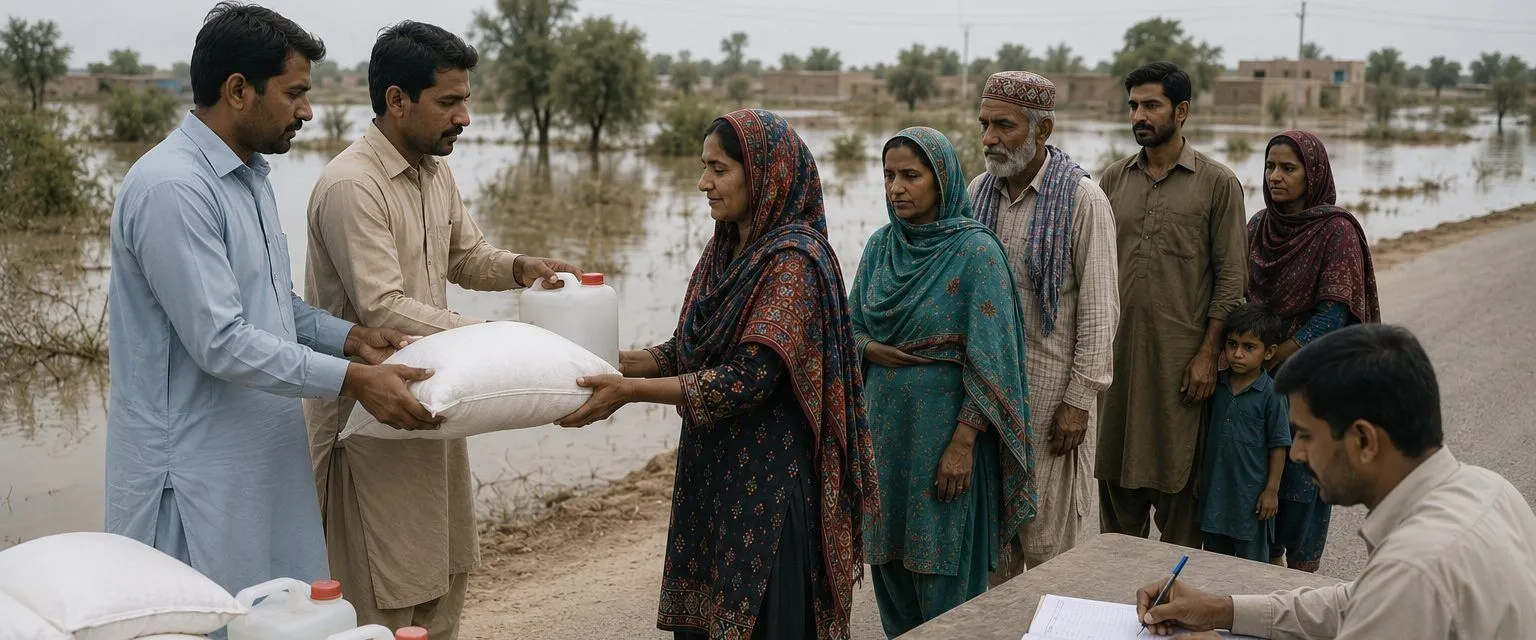
Emergency response for families across Pakistan. A household hit by a sudden emergency — a fire, a flood, the death of its earner — can ask for help through Request Help. The wider response capability below is being built in stages.
Emergency and Disaster Relief
Under Aim 5 of our constitution, PHWO will provide humanitarian assistance during emergencies, natural disasters and other situations of need through relief, food distribution and other welfare services.
The Need
Sindh has faced repeated large-scale flooding in recent years, and the province’s exposure to monsoon flooding, riverine and rain-fed inundation, heatwaves and displacement is well documented by the national and provincial disaster management authorities. Communities across the province have had to rebuild more than once in a single decade.
Two lessons come out of every one of those emergencies. The first is that the initial days matter most, and organisations that begin arranging supplies only after the water rises arrive late. The second is that distribution without verified lists produces the same result everywhere: the loudest and best connected are served first, and the households in the worst condition, often women-headed, elderly or disabled, are served last or not at all.
PHWO is building this capability now, before it is needed, because preparedness is the only part of disaster response that can be done calmly, for a household as much as for an organisation.
What PHWO Does
- Maintain a trained volunteer roster. Volunteers identified, briefed and contactable in advance, with defined roles for assessment, distribution, records and coordination.
- Maintain an emergency fund. A reserve held so that procurement can begin on day one rather than after a fundraising appeal has run its course.
- Pre-agree suppliers. A verified list of suppliers for food, water, tarpaulins, bedding, hygiene items and medicines, with indicative prices agreed in advance to avoid crisis pricing.
- Rapid needs assessment. Volunteers assess affected localities and produce verified beneficiary lists with local elders, school staff and health workers before distribution begins.
- Relief distribution. Food rations, clean drinking water, hygiene and dignity kits, bedding, mosquito nets and shelter materials, distributed against those lists with signed records of what was given, to whom and when.
- Medical response. Emergency medical camps with qualified professionals, linked to our Healthcare programme, addressing the water-borne and skin conditions that follow flooding.
- Attention to women and vulnerable groups. Female volunteers on distribution teams, dignity kits for women, and deliberate outreach to households that do not come forward.
- Coordination. Work under and alongside the district administration and disaster management authorities so that relief is coordinated and not duplicated, with warnings from the Pakistan Meteorological Department guiding when we move.
- Recovery support. Once the emergency phase closes, help affected families restart livelihoods and return children to school rather than withdrawing when the cameras leave.
- Emergencies that happen to one family. A house fire, the sudden death of the only earner, a medical emergency: help for households whose disaster never makes the news, through Request Help.
- Winter and seasonal relief. Blankets, warm clothing and bedding before winter, and ration for the poorest households at the times of year they need it most.
Who It Serves
Households affected by flooding, heat emergencies, fire, displacement or other disasters anywhere in Pakistan, where the necessary approvals permit us to respond. Priority within affected populations goes to women-headed households, older people, people with disabilities, pregnant and nursing mothers, and families who have lost their shelter or their means of earning. Relief is given on need alone, without regard to faith, sect, ethnicity or political affiliation.
How It Is Measured
- time from onset of an emergency to first distribution, our headline indicator of preparedness;
- households assessed and households assisted;
- relief items distributed by category, against signed distribution records;
- emergency medical camps held and patients treated;
- proportion of assisted households falling within priority vulnerable categories;
- independent verification checks on a sample of distributions;
- cost per household assisted;
- recovery follow-up at three months on livelihoods restarted and children returned to school.
Results will appear in our published activity and financial reporting. If no emergency occurs in a reporting period, we will report on preparedness instead: roster size, training held and fund balance.
How You Can Support It
- Give to the emergency fund. The most valuable donation to this programme is one made before a disaster, because it lets us act on day one. One hundred per cent of restricted gifts stay with this programme.
- Join the volunteer roster. Field coordinators, drivers, record keepers, doctors and paramedics are needed and are trained in advance. Apply through our Volunteer page.
- Pledge in-kind supplies. Suppliers and companies can pledge food, water, tarpaulins, bedding, hygiene items or transport to be released when needed.
- Partner. District administration, disaster management authorities, humanitarian organizations and CSR teams can pre-agree response arrangements with us. See Partner With Us.
To discuss supporting this programme, write to info@phwo.org.
Help us start this work
This begins when the people and the funding are there
Last reviewed . Published by Peace and Humanity Welfare Organization.