
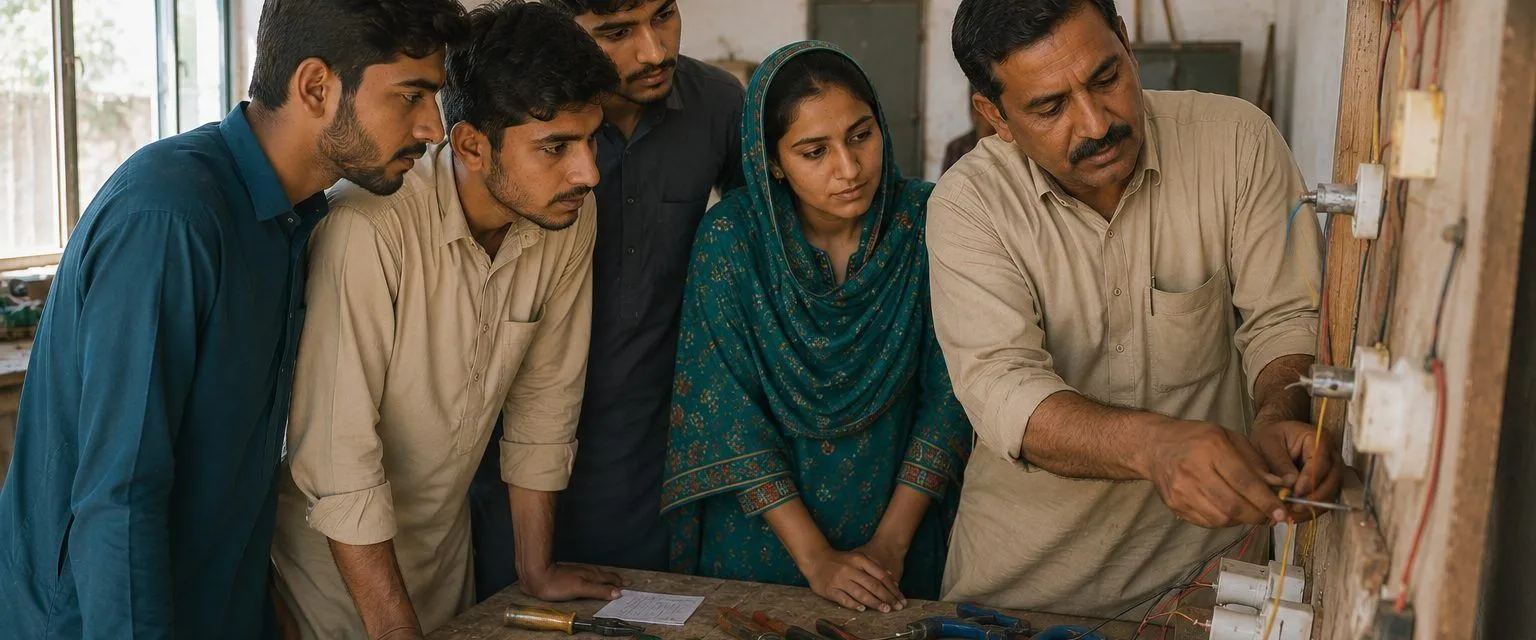
Skills that lead to work, for young people across Pakistan. Fees for a recognised technical course or skills programme can already be requested through Request Help. The training programme below opens in stages.
Youth Skills and Vocational Training
Under Aim 3 of our constitution, PHWO will empower youth through vocational training, technical education, entrepreneurship development and skills enhancement programmes for sustainable livelihoods.
The Need
Pakistan’s population is overwhelmingly young, and government labour statistics consistently show youth unemployment running well above the national rate, with the gap widest for young people in smaller districts. In smaller districts the pattern is easy to see: young men leaving for Karachi or the Gulf, and young people with degrees waiting years for a government post that may never open. The Pakistan Bureau of Statistics is where the national labour force surveys behind this picture are published.
At the same time, local employers say they cannot find trained technicians. Electricians, solar installers, air conditioning and refrigeration technicians, mobile phone repairers, motorcycle mechanics, plumbers, welders and machine operators are all in demand, and a competent one is rarely idle. The gap is not opportunity, it is certification-free, employer-relevant training that a young person from a poor household can actually access.
There is also a dignity dimension. Technical trades are undervalued relative to degrees, even though they often pay better and pay sooner. Part of this programme’s work is to make skilled trades a respected choice rather than a fallback.
What PHWO Does
- Trade skills training. Short, hands-on courses in electrical work, solar panel installation and maintenance, air conditioning and refrigeration, mobile phone and electronics repair, motorcycle and auto mechanics, plumbing, welding and fabrication, selected according to demand from local employers rather than by assumption.
- Technical education support. Assistance for deserving students in technical and vocational institutes, including fees, tools and transport.
- Employability skills. Workplace conduct, communication with customers, basic English, CV preparation, interviews, and how to quote for a job.
- Apprenticeship linkage. Placements with established workshops, contractors and businesses in participants’ own towns so that training ends in supervised real work, not a certificate.
- Toolkits on completion. Where a sponsor provides them, a basic set of tools for graduates, because a trained technician without tools cannot start.
- Entrepreneurship track. Support for graduates who want to set up their own shop or service, covering costing, customer acquisition, record keeping and reinvestment.
- Coordination with government schemes. Working with technical education authorities and existing skills programmes so that participants can access recognised certification where it is available; the Sindh Technical Education and Vocational Training Authority and the National Vocational and Technical Training Commission both publish details of recognised courses and certification.
- Career guidance and job placement. Counselling on which trades and courses lead to work, and introductions to employers who are hiring.
- Youth leadership and service. Young volunteers trained to organise community work, with responsibility that builds confidence and a record employers value.
- Wellbeing and drug-abuse awareness. Honest sessions for young people and parents, with referral to qualified help where it is needed.
Who It Serves
Young people aged 18 and above across Pakistan: school leavers, unemployed and underemployed youth, graduates without a route to work, and young people from families where an additional income is urgently needed. Places will be reserved for young women in trades where they can practise safely and acceptably. Selection is on need and commitment, without regard to faith, sect, ethnicity, gender or affiliation.
How It Is Measured
- participants enrolled and completing, by trade and by gender;
- apprenticeships and placements arranged;
- number employed or self-employed within six months of completion, our headline indicator;
- number still working at twelve months;
- average reported earnings before and after training;
- number who start their own workshop or service, and any employment they in turn create;
- employer feedback on the competence of participants;
- cost per participant placed in work, reported the way we set out in where your money goes.
Results are published once they are verified, in our activity and financial reporting.
How You Can Support It
- Fund a trade batch. A restricted donation covers trainers, workshop materials, safety equipment and toolkits for a full group, and one hundred per cent of it stays with this programme.
- Offer an apprenticeship. Workshops, contractors, dealerships and businesses anywhere in Pakistan can take a trainee for supervised practice.
- Teach a trade. Master technicians and experienced tradespeople are exactly who we need as instructors. Apply through our Volunteer page.
- Donate tools and equipment. Serviceable tools, instruments and workshop equipment are put straight into training or into graduates’ toolkits.
- Partner. Technical institutes, industry associations and CSR teams can sponsor or accredit cohorts. See Partner With Us.
To discuss supporting this programme, write to info@phwo.org.
Help us start this work
This begins when the people and the funding are there
Last reviewed . Published by Peace and Humanity Welfare Organization.