
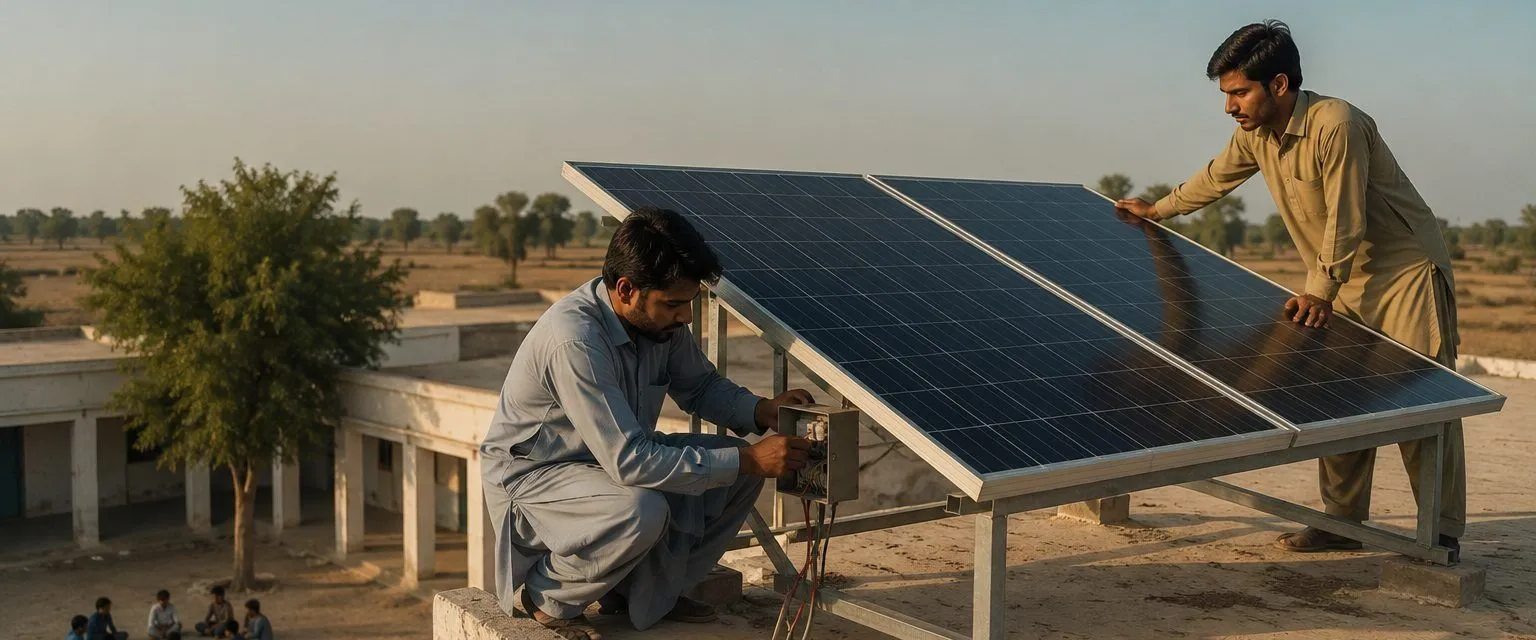
Environment and clean energy, for communities across Pakistan. The programme below opens in stages; volunteers, schools and partners can take part now through the volunteer and partner forms.
Environment and Renewable Energy
Under Aims 4 and 6 of our constitution, PHWO will promote environmental protection, cleanliness campaigns and tree plantation, and encourage sustainable development through renewable energy, environmental awareness and community-based initiatives.
The Need
Sindh sits at the sharp end of Pakistan’s climate exposure. Summers in upper Sindh — Larkana, Jacobabad and Dadu among them — are among the hottest recorded anywhere in the country, and residents know the cost of a heatwave without shade, without reliable electricity and without clean water. Recent years have also brought severe flooding to the province, and the communities hit hardest are usually those with the least capacity to recover. The Pakistan Meteorological Department issues the heat and monsoon advisories that decide when this work has to happen.
Two everyday problems compound this. Tree cover in and around our towns has thinned, removing the cheapest cooling technology ever devised. And solid waste accumulates in streets and drains, which in the monsoon turns a manageable rainfall into standing water, blocked drainage and disease.
On energy, load shedding and fuel costs are a permanent constraint. A child cannot study after sunset without light, a summer classroom without a fan empties, and a clinic without power cannot store what it needs to store. Small renewable installations solve these problems directly, and Sindh has no shortage of sun.
What PHWO Does
- Tree plantation with aftercare. Plantation drives with schools, colleges, mosques and local committees, using species suited to the local climate, with a named guardian for each batch of saplings and a watering plan for the first two summers. We will report survival rate, not planting count.
- Cleanliness campaigns. Neighbourhood clean-ups organised with residents and coordinated with local government, focusing on drains and waterways before the monsoon rather than after it.
- Environmental education. Sessions in schools on waste, water, heat safety and climate, plus student environment clubs that keep the work going between our visits.
- Solar demonstration and awareness. Community sessions showing what small solar systems cost, what they can and cannot do, and how to maintain them; the Alternative Energy Development Board is the national reference point for this.
- Renewable installations through partnership. Where funding partners allow, solar lighting for study spaces, fans and lighting for schools, and solar water pumps for communities without reliable clean water.
- Heat and water safety. Practical guidance before each summer on heatstroke prevention, safe drinking water and household water storage.
- Coordination. Work with the Forest, Environment and Local Government departments so that plantation sites and clean-up work are agreed rather than improvised.
- Clean water. Water filtration and safe water points for communities and schools without them, and summer drinking-water points during heatwaves.
- Waste and recycling. Community waste collection arrangements and awareness on separating and recycling waste.
- Flood-resilient practice. Guidance for households and communities on protecting homes, water and documents before the monsoon.
Who It Serves
Neighbourhoods, villages and schools across Pakistan, with priority for localities that flood, that lack shade or safe drinking water, or that suffer the worst summer heat. Students are a deliberate focus: environmental habits formed in school outlast any single campaign. All activity is open to the whole community without regard to faith, sect, ethnicity or affiliation.
How It Is Measured
- saplings planted, and sapling survival rate at six and twelve months, which is our headline indicator;
- sites planted and guardians assigned;
- clean-up campaigns held, localities covered and volunteers mobilised;
- drains cleared before the monsoon, with photographic before-and-after records;
- students reached through environmental education and clubs formed;
- solar units installed, and hours of usable light or pumping delivered;
- households reporting improved access to clean water where pumps are installed;
- cost per surviving tree and cost per installation, so donors see exactly what their giving buys.
Results are published once they are verified, in our activity and financial reporting.
How You Can Support It
- Fund a plantation drive. A restricted donation covers saplings, guards, tools and a two-year watering plan, and one hundred per cent of it stays with this programme.
- Sponsor a solar installation. Lighting for a school, a study space or a clinic, or a solar water pump for a community.
- Join a campaign. Volunteers are needed for every plantation and clean-up. Apply through our Volunteer page.
- Donate in kind. Saplings, tree guards, tools, gloves, waste bins, solar panels and batteries can all be deployed immediately.
- Partner. Nurseries, solar companies, local government and CSR teams with environmental commitments are natural partners. See Partner With Us.
To discuss supporting this programme, write to info@phwo.org.
Help us start this work
This begins when the people and the funding are there
Last reviewed . Published by Peace and Humanity Welfare Organization.