
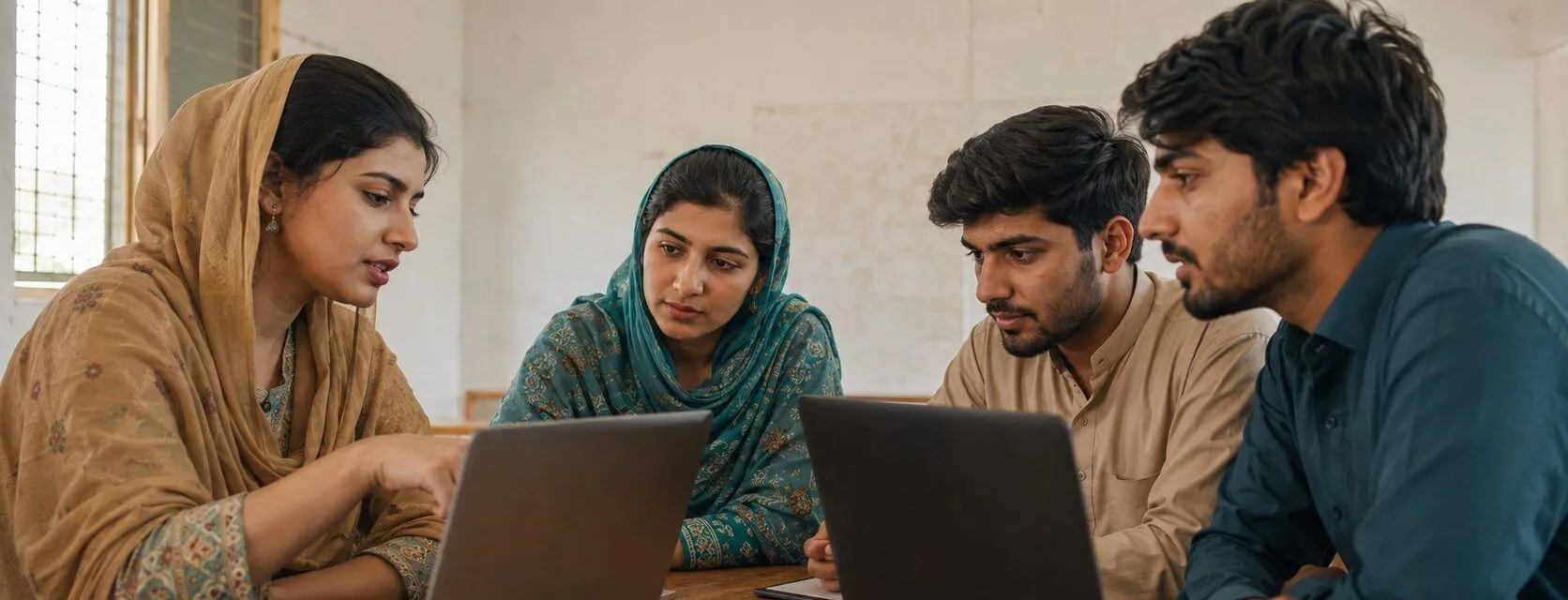
Every year, thousands of young people in Larkana and across interior Sindh finish a degree and discover that the number of formal jobs available locally is far smaller than the number of graduates. Migration to Karachi is expensive and, for many young women, not an option their families will accept, which is why skills that earn from home matter so much. Against that background, freelancing is often presented as the obvious answer. It can be. But the version sold in advertisements, where a laptop and a week of effort produce a foreign income, is not the version that works.
What follows is a realistic account of how a young person in interior Sindh can build freelance income: which skills genuinely pay, how to work around the electricity and connectivity situation, how money actually reaches a Pakistani bank account, how to get a first client when you have no reviews, and which scams to walk away from.
Start by understanding what clients are actually buying
A freelance client is not buying your degree or your enthusiasm. They are buying the removal of a problem: a website that will not load properly, a product catalogue that needs 400 descriptions written, a month of social media posts nobody on their small team has time to design, an accounting file that needs reconciling.
This has a practical consequence. The question is not “what do I want to learn?” but “what problem can I solve end to end, without supervision, in a language the client reads comfortably?” End to end matters. A client who has to explain the job three times, correct your output twice and still finish it themselves has not saved anything.
Skills that reliably pay, and roughly why
- Graphic design. Steady demand and a low equipment barrier. Social media graphics, logos, packaging, presentation decks. Competition is heavy at the bottom, so the money is in developing a recognisable style and a niche rather than in being the cheapest.
- Video editing. Currently one of the strongest areas, because every small business, coach and content creator produces video and almost none of them enjoy editing. Short-form vertical editing in particular is in demand. It needs a reasonably capable computer, which is a real cost to plan for.
- Web development. WordPress and Shopify work is the practical entry point: building, fixing, speeding up and maintaining small business sites. Maintenance retainers are more valuable than one-off builds because they produce predictable monthly income.
- Writing in English. Only worth pursuing if your written English is genuinely strong. It is a crowded field and standards have risen, so general “article writing” pays poorly. Specialist writing, where you understand an industry, still pays well.
- Virtual assistance and operations support. Inbox management, scheduling, data entry, customer support, order processing. Less glamorous, but it produces stable long-term relationships and is often the fastest route to a first steady client.
- Bookkeeping and spreadsheet work. Undervalued locally and useful if you have a commerce background. Small foreign businesses regularly outsource this.
- Amazon and e-commerce support. Listing optimisation, product research, store management. Popular in Pakistan; treat the training market around it with caution, as discussed below.
Notice what is missing: nothing here promises income without a skill. The organisations and advertisements that promise otherwise are selling something else.
The electricity and internet reality, planned for honestly
Load shedding is not an excuse a client will accept twice. The answer is not to hope the schedule improves but to design your working setup so that power interruptions do not touch your commitments.
- Work on a laptop, not a desktop, if you possibly can. A laptop is an uninterruptible power supply with a screen attached. A desktop plus UPS costs more and gives less.
- Solve the router first. A small battery-backed router unit, or a modest inverter, battery and solar arrangement dedicated only to the router and your laptop charger, will keep you connected through most outages. You do not need to power the whole house to keep working.
- Keep two connections. A fixed broadband line where available plus a mobile data SIM from a different operator. When one fails you switch, rather than explaining.
- Batch heavy uploads. If you edit video, render locally and upload during the hours your connection is most reliable. Learn your own network’s daily pattern and schedule around it.
- Set expectations by delivery date, not by hours. Promise “Tuesday”, not “this afternoon”. This absorbs local disruption invisibly and is also simply better professional practice.
- Communicate before, not after. If something will be late, the message goes out early. Clients forgive delay far more readily than silence.
Getting paid: the part most beginners get wrong
Before you take a single order, know exactly how the money will reach you. Being unable to withdraw earnings is a demoralising and entirely avoidable problem.
The main routes
- Payoneer, whose own site sets out current country availability, fees and verification requirements. It is the most widely used option among Pakistani freelancers, and provides receiving account details in several currencies, which lets you invoice international clients, and transfers to a local bank account. Verification requires your CNIC and a matching name, so make sure the name on your bank account, CNIC and Payoneer profile are identical.
- Wise. Useful for some corridors and generally transparent about fees, but availability of features for Pakistan-based users changes over time. Check the current capability listed on its own site before relying on it.
- Direct bank transfer. Many Pakistani banks now support inbound remittances for freelancers, and several offer accounts aimed specifically at this. Ask your branch what documentation they want.
- Marketplace withdrawal. Platforms such as Fiverr and Upwork, whose help pages set out their own payout schedules, hold your earnings and pay out to a linked method, usually Payoneer or a bank transfer.
Practical points
- Route income through formal banking channels. Informal transfers may look convenient but leave you with no record, no protection and potential legal exposure.
- Keep records. Invoices, contracts and bank statements matter when you want a larger account, a loan, a visa or simply proof of income.
- Understand the fee stack. Platform commission, currency conversion and withdrawal charges together can take a meaningful share. Price with that in mind rather than discovering it afterwards.
- Freelance income has tax implications in Pakistan and the rules change. The Federal Board of Revenue publishes current filing requirements, but ask a local tax practitioner once, early, rather than guessing for three years.
Getting the first client when you have no reviews
The first order is the hardest, and the usual advice, “just apply on Fiverr”, is inadequate because it ignores the cold-start problem. A few approaches work better.
- Build three portfolio pieces before you build a profile. Not certificates. Actual work. Redesign the menu of a restaurant you know. Edit an existing YouTube video into a sharp sixty-second cut. Rebuild a badly built local business website as a demonstration. Be clear that these are self-directed samples, never that they were paid commissions.
- Start locally. Larkana, Sukkur and Shikarpur are full of shops, clinics, schools and small manufacturers with no digital presence at all. Local work pays less but it gives you real clients, real deadlines, real feedback and testimonials you can honestly show.
- Write proposals that mention the client’s specific situation. Most applicants send the same paragraph to everyone, and clients can tell instantly. Two sentences showing you looked at their business will outperform a long generic pitch.
- Be narrow. “I edit podcast interviews for coaches” wins against “I do video editing, graphic design, web development and writing”. Breadth reads as inexperience.
- Deliver the first small job unreasonably well. Repeat clients and referrals are where freelance income becomes stable. The first job is a marketing expense.
Scams and traps to avoid
Where young people are eager and money is scarce, exploitation follows, so check who you are dealing with as carefully as you would a charity. Recognise these patterns.
- Guaranteed-income courses. Nobody can guarantee freelance earnings. Training that promises a fixed monthly figure is selling a fantasy, and the fee is the actual business model.
- Pay-to-join “agencies”. A legitimate agency pays you. If you are asked to pay for access to work, walk away.
- Unpaid “test tasks” that are really the job. A short sample is normal. A complete deliverable for free is theft.
- Requests to move off-platform immediately. This removes your protection and any dispute mechanism. It is also the standard preamble to non-payment.
- Overpayment and refund scams. A “client” sends more than agreed and asks you to return the difference. The original payment is later reversed.
- Account renting and identity lending. Being asked to open a Payoneer or bank account in your name for someone else’s use is not a shortcut. It exposes you to money-laundering liability.
- Crypto “investment” pitched alongside freelancing. Two unrelated things bundled together, usually by someone whose income comes from recruiting you.
A realistic timeline
Expect three to six months of consistent daily practice before your skill is saleable, and a further few months before income is regular. Anyone shortening that estimate is selling something.
Where PHWO fits
Peace and Humanity Welfare Organization is a welfare organisation serving families across Pakistan, with its registered office in Larkana, Sindh. Our Digital and Freelancing Skills programme is designed around exactly the constraints described above: a single marketable skill taught to a working standard rather than a survey of many, honest guidance on payments and documentation, portfolio work built with real local businesses, and no promise of guaranteed income. Experienced freelancers who would like to teach can offer their time.
In short
Freelancing from interior Sindh is difficult but genuinely possible. It rewards patience, narrow specialisation, professional communication and a working setup that treats power cuts as a solved problem rather than a recurring crisis. It punishes shortcuts. If you are willing to spend a year becoming genuinely good at one thing that businesses pay for, the geography stops being the obstacle it appears to be.