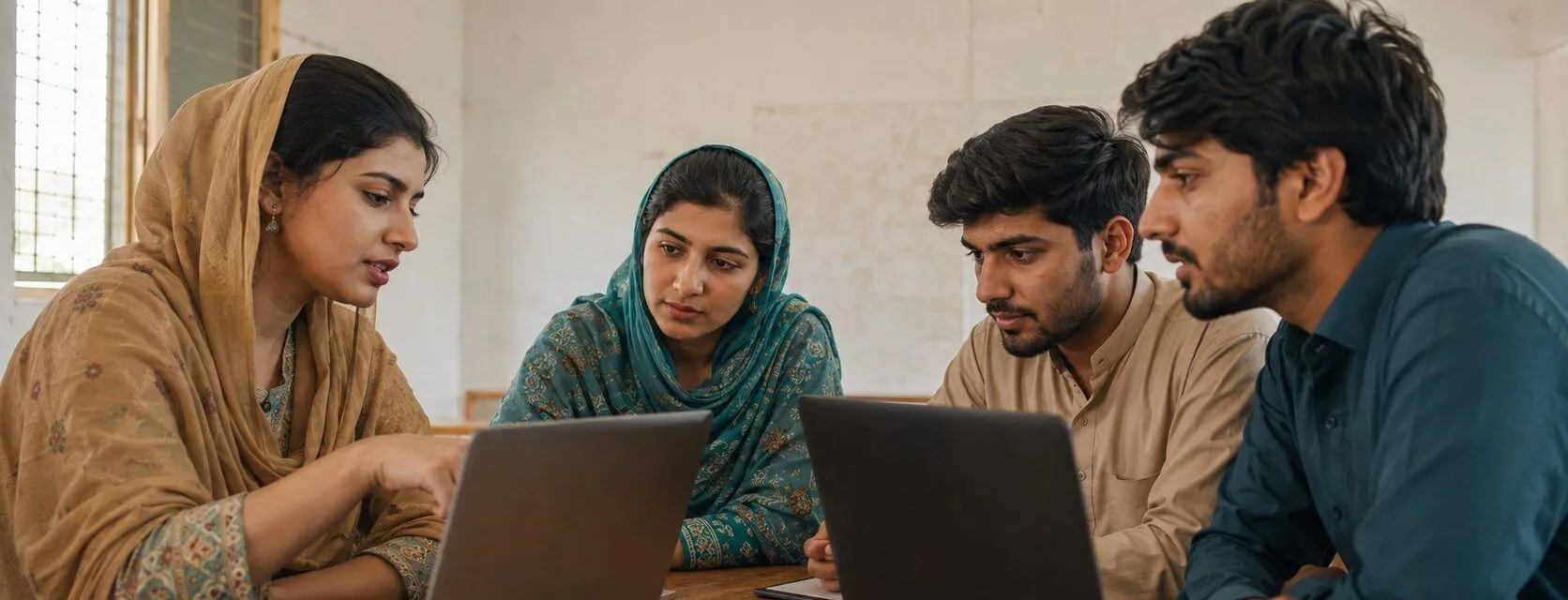
A flagship programme for young people and women across Pakistan. Anyone who needs a laptop or phone to study or work can already ask through Request Help. The training programme below opens in stages, in person and online.
Digital and Freelancing Skills Development
This is our flagship programme. Our constitution specifically provides for digital and freelancing skills work, and our founding members made it a priority for a simple reason: it is the fastest route we know to real income for young people and women in towns and villages across Pakistan, and it does not require them to leave home to find it.
The Need
Pakistan has one of the youngest populations in the world and one of the largest freelancing workforces, and government and industry reporting consistently show digital exports growing year after year. Almost all of that activity is concentrated in the big cities. Talent in smaller towns and districts is not less capable, it is less connected.
The result is familiar in households across the country. A young graduate finishes their degree and finds that the only path to a decent income runs through Karachi, Hyderabad or abroad, at the cost of rent, separation from family and, for most young women, the door closing entirely.
Remote work removes that constraint. A client in Karachi, Dubai or London does not care which district a designer, writer, video editor, bookkeeper or developer sits in. What stands between a young person in a small town and that market is a defined set of learnable things: a marketable skill, working English or clear written communication, a professional profile, the ability to handle a client, and a legitimate way to receive payment. Every one of those can be taught.
What PHWO Does
- Digital literacy foundation. Computer and smartphone fundamentals, internet safety, email, documents and spreadsheets, online research and typing speed, for participants starting from zero.
- Marketable skill tracks. Structured courses in graphic design, video editing, content and copywriting, virtual assistance and data entry, social media management, e-commerce store support, bookkeeping, and an introductory web development track for those who are ready for it, supported by free open curricula such as freeCodeCamp.
- Freelancing practice. How the major freelancing platforms work, Upwork among them, building a profile and portfolio, writing proposals that get replies, pricing, scope, deadlines, revisions, ratings and handling difficult clients.
- Client communication. Practical professional English and written communication, because a competent freelancer who cannot answer a client clearly will not get a second order.
- Payments and compliance. How to receive international payments through lawful channels, one of which is a remittance service such as Payoneer, keep simple records of earnings, and understand basic obligations.
- Women-only cohorts. Separate batches taught by women, run alongside our women’s empowerment work, in accessible venues at suitable hours, so that families are comfortable and women can actually attend.
- Mentoring after the course. Continued support until the first order is delivered, which is where most self-taught freelancers give up.
- Entrepreneurship track. For those who go further: building a small agency, subcontracting to other trained participants, including graduates of our youth and vocational training, and creating local employment.
- Learning from anywhere. Online and blended cohorts, so that a participant does not have to live near a training centre to take part.
- Devices and connectivity. Laptops, smartphones and internet packages for committed learners who cannot afford them, through sponsors and Request Help.
- A track for people with disabilities. Accessible teaching and remote work routes for people for whom a workplace is the barrier.
Who It Serves
Young people and women aged 18 and above across Pakistan — including those in smaller towns and villages who can learn remotely: unemployed and underemployed graduates, college students, school leavers, home-based women, and people with disabilities for whom remote work removes a barrier that a workplace would not. Selection is by need and commitment, assessed through a short application and interview, and made without regard to faith, sect, ethnicity, gender or affiliation. A meaningful share of every intake will be reserved for women.
How It Is Measured
Attendance is not success. Income is. Our indicators are:
- participants enrolled and participants completing, by track and by gender;
- profiles created on freelancing platforms and portfolios completed;
- number who earn their first payment, which is our headline indicator;
- total earnings reported by participants at three, six and twelve months;
- number still earning after six months, which tests whether the skill held;
- number who progress to regular clients, retainers or employment;
- cost per participant earning their first income;
- reasons for drop-out, recorded and published as honestly as everything else we commit to reporting.
Results are published once they are verified, in our activity and financial reporting.
How You Can Support It
- Fund a cohort. A restricted donation covers trainers, computers, internet, venue and mentoring for a full batch, and one hundred per cent of it stays with this programme.
- Donate hardware or connectivity. Working laptops and desktops, monitors, headsets and sponsored internet are the constraint that limits how many people we can train at once.
- Teach or mentor. Working freelancers, designers, developers, marketers and editors can train a module or mentor participants remotely from anywhere in the world.
- Hire. Give a trained participant their first order. Nothing accelerates a freelancer like a first completed job and a first review.
- Partner. IT companies, universities, training institutes, CSR teams and development organizations can sponsor, accredit or co-deliver cohorts. See Partner With Us.
To discuss supporting this programme, write to info@phwo.org.
Help us start this work
This begins when the people and the funding are there
Last reviewed . Published by Peace and Humanity Welfare Organization.