Women’s empowerment runs through all of PHWO’s work. Women can already ask for financial help through Request Help, and for a lawyer — for khula, maintenance, custody or inheritance — through Free Legal Aid. The training and livelihood programme below opens in stages across Pakistan.
Women’s Empowerment
Under Aim 3 of our constitution, PHWO will empower women through vocational training, technical education, entrepreneurship development and skills enhancement programmes for sustainable livelihoods.
The Need
Government labour force surveys in Pakistan consistently show female participation in paid work far below male participation, and lower still in rural Sindh. That gap is not a measure of ability or of willingness. It reflects distance, transport, safety, family expectations about women travelling to a workplace, and the simple fact that much of the work available is not work a woman can take.
Meanwhile, millions of women across Pakistan already possess real skills. They stitch, embroider, cook, teach and manage households on impossibly tight budgets. What is usually missing is the bridge between a skill and an income: knowing what sells, what to charge, how to find buyers beyond the neighbourhood, and how to receive and keep money in her own name.
Household economics make this urgent. When a woman earns, spending on children’s schooling, nutrition and healthcare rises. Supporting a woman’s livelihood is the most efficient way we know to reach an entire family.
What PHWO Does
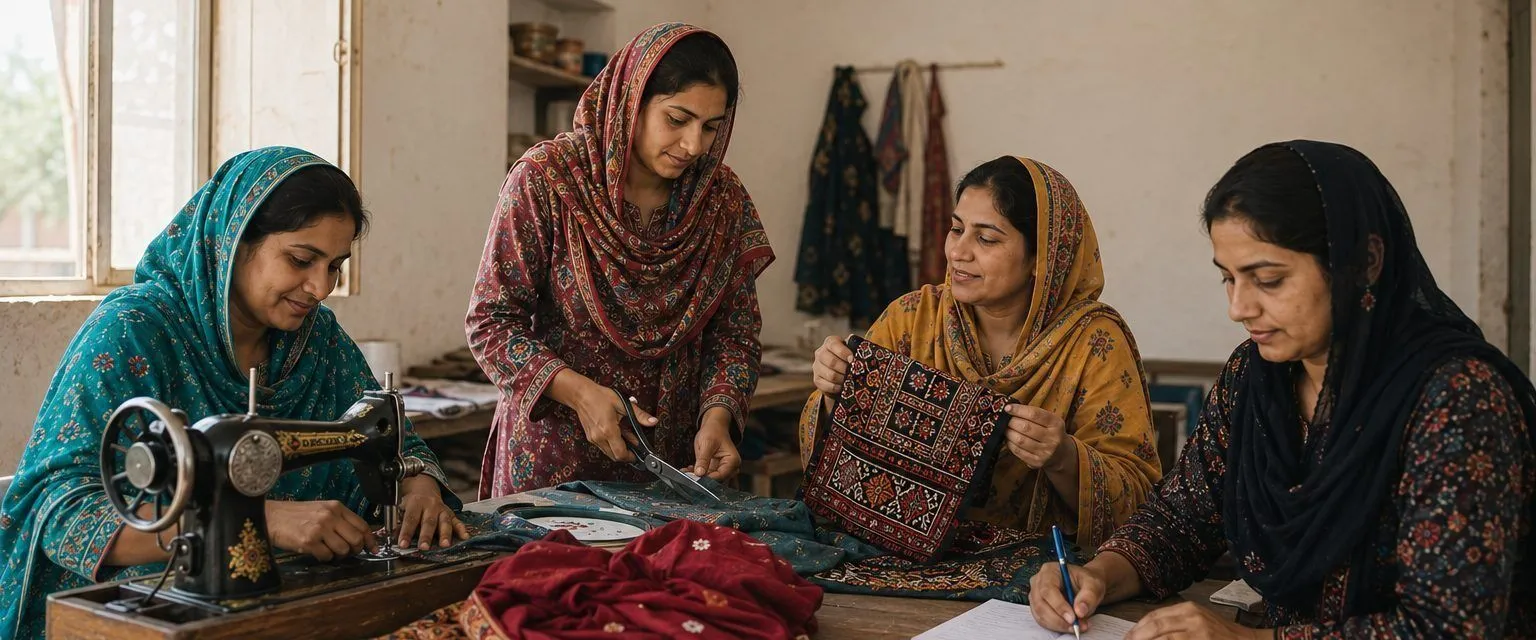
- Vocational training that ends in income. Courses in stitching and tailoring, embroidery and handicrafts, beauty and salon skills, food preparation and other trades with proven local demand, selected by surveying what actually sells before we teach it.
- Home-based and digital earning routes. Options that do not require daily travel, linked to our Digital and Freelancing Skills programme, with dedicated women-only cohorts.
- Entrepreneurship and business basics. Costing and pricing, quality and finishing, packaging, customer handling, simple record keeping, and how to open and operate a bank or mobile wallet account in her own name, for which the State Bank of Pakistan sets the rules banks must follow.
- Delivery designed around women’s reality. Women-only classes taught by women, held in venues within walking distance, at hours that fit household responsibilities, with the family informed and comfortable.
- Market linkage. Introductions to local shops, buyers, exhibitions and online marketplaces so that trained women have somewhere to sell.
- Rights and health awareness. Practical sessions on legal rights, documentation such as CNIC registration, which is handled by NADRA, and maternal and family health.
- Free legal help. Volunteer advocates for women who cannot afford a lawyer in cases of khula, divorce, maintenance, child custody, inheritance and property, through our Free Legal Aid service.
- Support for widows and women heading households. Help with ration, rent, school fees and medical costs through Request Help, alongside a route into training and income.
- Health for women and mothers. Maternal and newborn care and women’s health through our Health and Medical Care programme.
- Literacy and education. Women-only literacy and numeracy classes, and support for girls and young women to finish their education.
Who It Serves
Women aged 18 and above from low-income households across Pakistan, with priority for widows, women heading households, women with disabilities and those with no current source of income. Younger women who have left education early will be considered where family consent and safeguarding conditions are met. Selection is on need alone, without regard to faith, sect, ethnicity or affiliation.
How It Is Measured
- women enrolled and women completing, by course;
- first income earned after training, which is our primary indicator, not attendance;
- number continuing to earn three and six months after completion;
- number who open and use a bank or mobile wallet account in their own name;
- number linked to a buyer, shop, exhibition or online marketplace;
- drop-out reasons, recorded honestly so that the next cohort is designed better;
- cost per woman earning, so that donors can see the real return on what they give.
Results are published once they are verified, in our activity and financial reporting.
How You Can Support It
- Fund a cohort. A restricted donation covers trainers, materials, equipment and venue for a full group of women, and one hundred per cent of it stays with this programme.
- Donate equipment. Sewing machines, tools, salon equipment and raw materials convert directly into livelihoods.
- Train. Experienced women trainers in any of these trades are needed. Apply through our Volunteer page.
- Buy. Shops, boutiques, hotels and companies that purchase from trained participants create the demand that makes the training worth doing.
- Partner. CSR teams, vocational institutes and development organizations can sponsor or accredit cohorts. See Partner With Us.
To discuss supporting this programme, write to info@phwo.org.
Help us start this work
This begins when the people and the funding are there
Last reviewed . Published by Peace and Humanity Welfare Organization.