
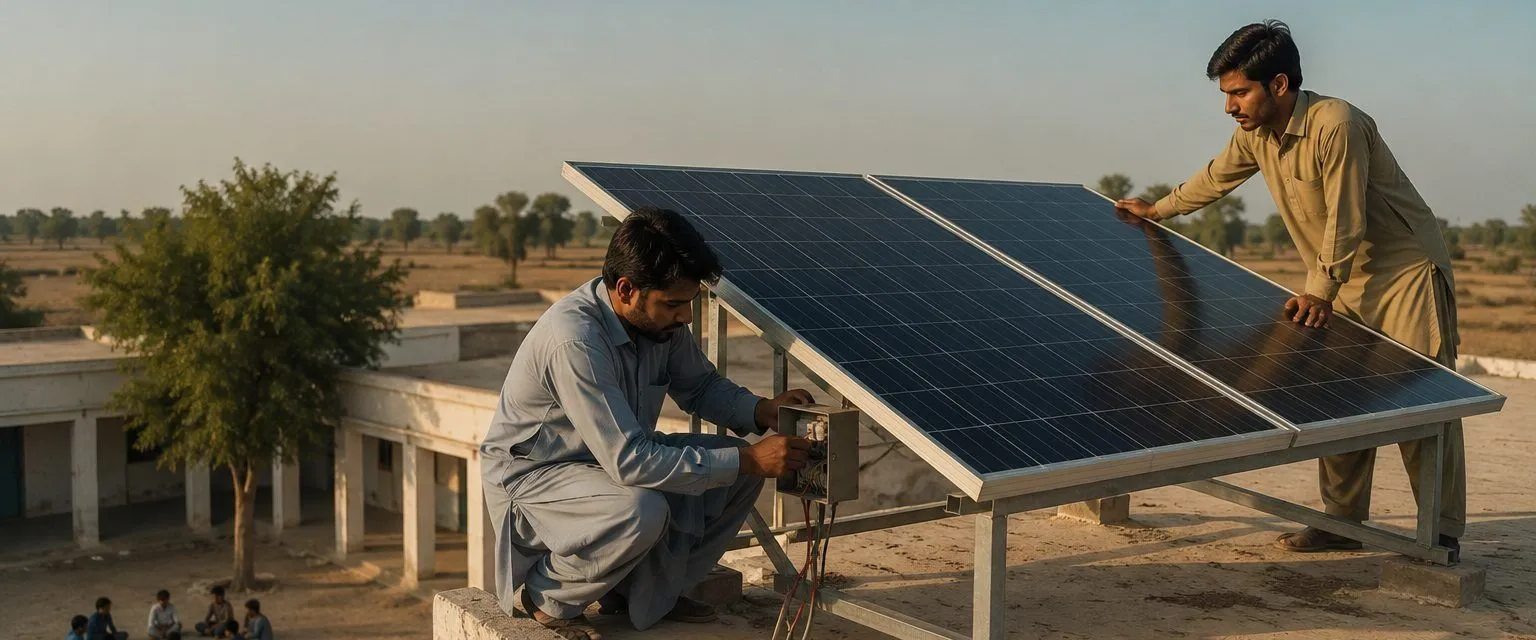
Solar has changed from an expensive novelty into an ordinary household purchase across Pakistan. Panel prices have fallen dramatically over the past decade, grid electricity has become more expensive and less reliable, and in interior Sindh, where summer temperatures make a working fan a matter of health rather than comfort, the calculation has become straightforward for many households.
What has not kept pace is practical knowledge. A great deal of money is wasted on systems that are the wrong size, batteries that die within a year, and installations that were never going to power what the buyer expected. This article covers what a small system realistically runs, how to think about the cost, how batteries work in practice, what maintenance is required, and the mistakes that recur most often.
Start with what you want to run, not with what you want to buy
The most common error is buying a system by panel wattage and hoping. The correct order is the reverse: list your loads, work out daily energy use, then size the system.
Approximate power draws, useful for rough planning:
- LED bulb: 7 to 12 watts
- DC ceiling fan: 35 to 45 watts
- Conventional AC ceiling fan: 70 to 100 watts
- Mobile phone charger: 5 to 15 watts
- Wi-Fi router: 10 to 15 watts
- Laptop: 45 to 90 watts
- Television: 50 to 120 watts
- Refrigerator: cycles, but assume roughly 1 to 1.5 units per day for a standard model, more in extreme heat
- Water pump, half horsepower: around 400 watts while running, with a much higher surge at startup
- Air conditioner, one ton inverter type: roughly 900 to 1,200 watts while running
- Iron, kettle, water heater: 1,000 to 2,000 watts each
Multiply each by the hours you expect to use it, and add the results. That daily figure in watt-hours is the number every subsequent decision depends on.
What a small system realistically powers
A modest system in the range of roughly 500 to 800 watts of panels, with a suitable battery, will comfortably run several LED lights, two or three DC fans, phone charging and a router through the evening and night. That is a genuinely life-changing configuration for a rural household, and it is the configuration most people should start with.
A mid-size system of around 1.5 to 3 kilowatts can add a refrigerator, a television, a laptop and a small water pump used during daylight hours. The laptop matters for anyone attempting remote work from home.
Air conditioning, electric irons, kettles and electric water heating belong in a different category. They are high-power loads and pushing them onto a small system is the origin of most disappointment. If air conditioning is the goal, that must be the design brief from the outset, not an addition afterwards.
The cost logic
Prices move, so specific rupee figures date quickly. The structure of the cost, however, is stable and worth understanding.
- Panels are now the cheapest major component per unit of output, and have been falling for years.
- The battery is usually the largest single cost in an off-grid or hybrid system, and it is the component that will need replacing.
- The inverter is the second significant cost and the component where quality differences matter most.
- Wiring, mounting structure, protection devices and labour are commonly underestimated and frequently where installers economise at your expense.
The useful way to evaluate a purchase is over its lifetime, not at the moment of sale. Panels typically carry long performance warranties and often outlast expectations. A lead-acid battery may last around two to four years with good care and considerably less with poor care; lithium iron phosphate batteries cost substantially more initially but usually last far longer and tolerate deeper discharge. Over eight or ten years, the cheaper battery is often the more expensive choice.
Compare, honestly, against what you currently spend: monthly electricity bills, petrol or diesel for a generator, UPS battery replacements, and the cost of what you go without. For many low-income households in interior Sindh, a small system pays for itself within a few years, and a fan running through a summer night is a benefit no spreadsheet captures.
Batteries: the part that determines success
Nearly every disappointing solar installation is really a battery problem.
- Depth of discharge matters enormously. A lead-acid battery routinely drained to empty will fail quickly. Plan to use roughly half of its rated capacity, which means you need roughly twice the capacity your load calculation suggests. Lithium batteries tolerate much deeper discharge, which is a substantial part of their value.
- Heat shortens battery life, and Sindh summers are severe. Batteries should be in a shaded, ventilated space, never in direct sun and never sealed in an unventilated cupboard.
- Flooded lead-acid batteries need water. Distilled water only, checked regularly, never tap water. This single omission destroys more batteries in Pakistan than any other cause.
- Terminals need cleaning. Corrosion produces resistance, heat and unexplained poor performance.
- Do not mix old and new batteries, or different types or capacities, in one bank. The weakest unit drags down the rest.
- The charge controller must match the battery type, and an MPPT controller will extract meaningfully more energy than a cheaper PWM unit, particularly in winter and on cloudy days.
Panels, inverters and installation
Panels should face broadly south in Pakistan, tilted at roughly the local latitude, which for Sindh means a modest angle. Some installers mount panels flat because it is easier and cheaper. Flat panels collect dust far faster and lose output accordingly. The Pakistan Meteorological Department publishes local weather and sunshine data that is useful when planning a site.
Shading is more damaging than people expect. A single shadow from a water tank, a tree branch or a neighbour’s wall falling across part of a panel can reduce the output of a whole string. Observe the site through a full day before deciding on placement.
On inverters, insist on a pure sine wave unit. Modified sine wave inverters cost less and cause fans to hum, motors to run hot and some electronics to fail early. Check the surge rating if you intend to start a pump or a refrigerator compressor, since starting current is several times running current.
Installation quality is where the greatest hidden risk sits. Look for adequate cable thickness, since undersized cable is a fire risk and a persistent efficiency loss; proper fusing and circuit protection on both DC and AC sides; correct earthing; a mounting structure that will survive high wind; and, if the system is grid-tied or has any grid interaction, a compliant arrangement with the distribution company. Net metering exists in Pakistan and can be worthwhile, but it involves an approval process and is more relevant to urban and larger installations than to a small rural off-grid setup. The Alternative Energy Development Board is the national body that publishes policy in this area.
Schools and clinics: different requirements
Institutional installations have a distinct set of needs and a distinct failure pattern.
For a rural school, the practical priorities are lights and fans in classrooms, since heat drives both attendance and learning down, and power for any computer equipment. For a basic health unit or clinic, the priorities are lighting for the examination and delivery area, a fan, and above all a reliable supply for vaccine refrigeration. Vaccine cold chain is a critical load and should be designed as one, with autonomy for several days rather than several hours. The World Health Organization publishes guidance on vaccine cold chain requirements.
The recurring institutional failure is not technical. It is that nobody owns the system. Panels go uncleaned, batteries go unwatered, a fault appears and no one has a budget or a contact number, and within two years an expensive installation is dead. Any institutional solar project should include a named responsible person, a small annual maintenance budget, a service contract or a trained local technician, and a battery replacement fund started from day one. Without those four, the installation is a donation with an expiry date.
Common mistakes
- Undersizing the battery while oversizing the panels, so the system performs well at noon and fails at night.
- Buying to a price and receiving a modified sine wave inverter, thin cable and no protection devices.
- Expecting air conditioning from a system never designed for it.
- Never cleaning the panels. Dust in Sindh accumulates quickly and can cut output substantially. Wash with water in the early morning or evening, never with cold water on hot glass in midday sun.
- Ignoring the battery water level until the battery is finished.
- Adding loads over time without revisiting the design, then blaming the system.
- Buying counterfeit or misrated panels. Insist on a proper invoice, a named brand, and written warranty terms. A panel labelled 550 watts that delivers far less is a common complaint.
- No after-sales relationship. Buy from someone locally reachable. An unbeatable price from a distant seller is worth little when an inverter fails.
A sensible way to proceed
Start small, with lights, fans and charging. Live with it through one full summer. Then expand deliberately, with the battery bank sized for the new load rather than hoping the old one copes. Systems built this way tend to keep working; systems bought all at once on a salesman’s recommendation often do not.
Where PHWO fits
Peace and Humanity Welfare Organization is a welfare organisation serving families across Pakistan, with its registered office in Larkana, Sindh. Our focus in this area is on schools and small health facilities, and in the maintenance question above rather than the installation alone. A panel on a roof with no one responsible for it is not a solved problem, and we would rather plan for year five than for the opening day. Our thinking on this sits within our environment and energy programme, and readers who want to help fund that work can contribute towards it.