
Every organisation working in social welfare receives more offers of help than it can use, and simultaneously struggles to find the help it actually needs. This is not ingratitude. It reflects a real mismatch between what most volunteers offer, which is a day, and what most work requires, which is months.
Volunteering is genuinely valuable, and in a country where the state’s reach is uneven and resources are thin, it is often the difference between something happening and nothing happening. But there is a version of volunteering that costs an organisation more than it contributes, and a version that quietly transforms what a small organisation can do. This article is about telling them apart, written for people who want to give their time well and for organisations deciding how to use it.
The distinction that matters
Consider two people.
The first arrives with twenty friends and a van of food packets on a Saturday, distributes them in a village none of them has visited before, takes photographs, and posts them that evening. The village receives food it did not choose, in quantities that will last a few days, and will not see these people again.
The second visits the same village every Sunday for a year, teaches thirty children to read, learns the names of their parents, notices which child has stopped coming and finds out why, and is still there in the second year.
Both are volunteering. Only one of them changes anything. The difference is not sincerity, and the first group is not acting in bad faith. The difference is that consistency compounds and one-off events do not.
Why performative charity persists
It persists because it is emotionally satisfying, easy to organise, highly visible, and produces immediate gratitude. Sustained work is none of those things. It is repetitive, slow, largely invisible, and its results are hard to photograph. Anyone volunteering seriously should expect the second experience and be suspicious of activities that feel like the first.
This is not an argument against distributions. Emergency relief after a flood is necessary and urgent, and speed matters more than elegance in the first days of a disaster. The problem is treating relief techniques as though they were development, and treating a single day as though it were a programme.
Showing up consistently
If there is one principle in this article, it is this: reliability is the scarcest volunteer quality and the most valuable.
An organisation can plan around a volunteer who comes every Tuesday from four until six. It cannot plan around a volunteer who comes enthusiastically for three weeks and then stops answering messages. Worse, in work involving children, an adult who appears, builds a relationship and then disappears without explanation does genuine harm, because these are often children for whom adults disappearing is already a pattern.
Practical implications:
- Commit to less than you think you can manage. Two hours a week sustained for a year beats a day a week sustained for a month.
- Agree a defined period, three months or six, and review it rather than drifting away.
- If you must stop, say so, give notice, and hand over properly. Ending well is part of volunteering well.
- Treat it as you would a job. Arrive on time, tell someone if you cannot come, and do the unglamorous parts.
Skills that are genuinely needed
Small organisations are almost always short of technical capability rather than willing hands. If you have professional skills, offering those is worth far more than offering to carry boxes.
- Bookkeeping and accounts. Perpetually needed, rarely offered. An organisation with clean books can be audited, can approach institutional donors, and can prove its integrity. This is among the highest-value contributions available.
- Teaching, particularly remedial reading and mathematics. Consistent, patient, small-group teaching at the level the child is actually at.
- Health professionals. Not only for camps but for training community health volunteers, developing referral protocols and reviewing clinical practice, areas where the World Health Organization publishes training and protocol material.
- Legal knowledge. Registration, compliance, employment matters, and helping people obtain identity documents, which are issued through NADRA.
- Data and monitoring. Designing a simple system for recording beneficiaries and outcomes, and analysing it honestly. Most small organisations collect data they never use.
- Writing and translation. Proposals, reports, and translating materials into Sindhi so that they are actually read.
- Digital skills. Website, basic security, spreadsheets, and training staff to use tools rather than doing it for them.
- Vocational trades. Tailoring, electrical work, solar maintenance, agriculture. People who can teach a trade to a working standard are rare and valuable.
- Governance. Serving on a board, asking hard questions, and improving accountability, of the kind set out in our own governance arrangements.
Diaspora volunteers can contribute a great deal remotely: bookkeeping, proposal writing, online tutoring, website work, mentoring young freelancers, and connecting an organisation to institutional funders. Remote contribution suffers less from the disruption of visits and is often more sustainable.
Working with communities rather than for them
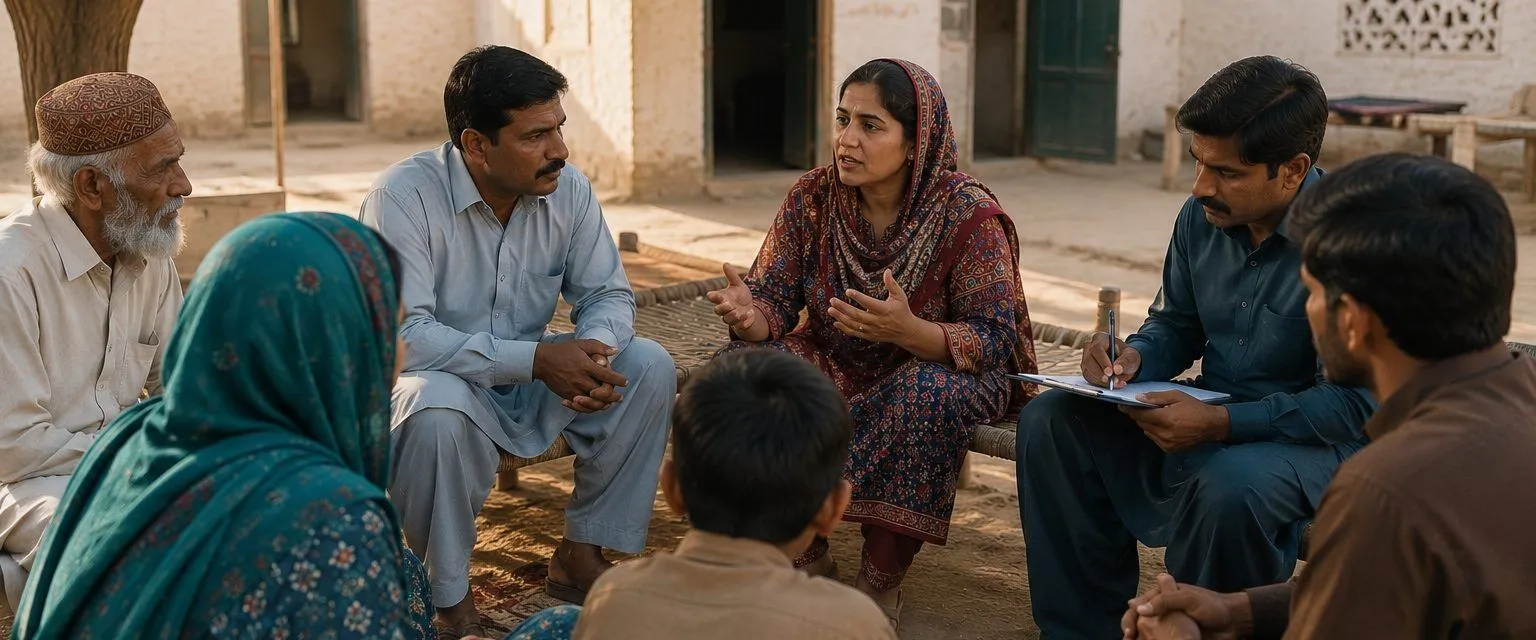
The most common failure in well-intentioned volunteering is arriving with a solution. The community already knows what its problems are and has usually thought about them longer than you have. What it may lack is resources, technical input or an outside connection.
In practice this means:
- Ask before proposing. Spend the first visits listening. If you cannot name three things the community itself identified as priorities, you are not ready to design anything.
- Talk to people who are not the obvious spokesmen. Women, young people, landless labourers and members of marginalised groups often have entirely different priorities from those the village leadership presents.
- Work through what exists. The school head, the lady health worker, the imam, the union council. Bypassing local institutions weakens them and guarantees that your work ends when you do.
- Expect contribution. Labour, land, a room, a share of the cost. Something given by the community is something maintained by the community. Things provided entirely free are frequently not maintained at all.
- Plan the handover from the beginning. Who runs this when you stop coming? If the answer is nobody, reconsider the design.
- Learn the language, or work with someone who has it. Programmes run in Urdu in Sindhi-speaking villages lose a great deal, particularly with women and older people.
- Do not promise. Communities have often been promised a great deal by visitors who did not return. Say what you will actually do, and only that.
Safeguarding basics
Anyone volunteering with children or vulnerable adults takes on a duty of care. These are minimum standards, not optional refinements, and they protect the volunteer as much as the participant.
- Never be alone with a child in a private or unobserved space. Work in open rooms, with doors open, with another adult present. This is the single most important rule.
- No photographs of children without informed consent from a parent or guardian, and none at all where the image would be undignified. UNICEF publishes child safeguarding standards that organisations can adopt. Never publish a child’s full name alongside their photograph, and never a location that identifies where an individual child can be found.
- No private contact. Do not exchange personal phone numbers or message children directly. Communication goes through the organisation and through guardians.
- Respect gender norms and work within them. Female volunteers with women and girls, male volunteers with men and boys, where the community expects it. This is not a compromise of principle; it is what makes access possible at all.
- Know how to report a concern and report it rather than investigating it yourself. Every organisation should have a named person for this and a route for raising concerns, as our complaints procedure describes, and if it does not, that tells you something.
- Do not give money or gifts to individual participants. It creates dependency, resentment among others, and a relationship that is difficult to unwind.
- Protect data. Names, addresses, health details and photographs are not yours to share. A beneficiary list on an unlocked phone is a real risk.
- Stay within your competence. Do not give medical, legal or psychological advice you are not qualified to give. Referral is not a failure; it is the correct action.
Questions to ask an organisation before you volunteer
- What specifically do you need, and for how long?
- Who will I report to, and who trains me?
- Do you have a safeguarding policy, and who is the designated person?
- Will I be working with children or vulnerable adults, and what checks apply?
- How was this activity decided on, and were the community involved?
- What happens to this work if I stop?
- Are expenses covered, and what am I expected to bear myself?
An organisation that cannot answer these is not ready for volunteers, and joining it may waste your time and its own. Much the same list is useful when deciding which organisation deserves your money.
Where PHWO fits
Peace and Humanity Welfare Organization is a welfare organisation serving families across Pakistan, with its registered office in Larkana, Sindh. We ask volunteers for defined commitments over months rather than single days, put safeguarding arrangements in place before working with children, and are honest with volunteers about how ordinary most of the work will be. We would also rather turn down help we cannot use well than accept it and waste someone’s time. If you would like to take part, you can register your interest or become a member.
A final thought
The most useful volunteers are usually the least visible ones: the person who reconciles the accounts every month, the teacher who is still coming in the second year, the retired doctor who trains health workers instead of seeing patients for a day. None of that photographs well. All of it is what actually accumulates into something a community can rely on.