
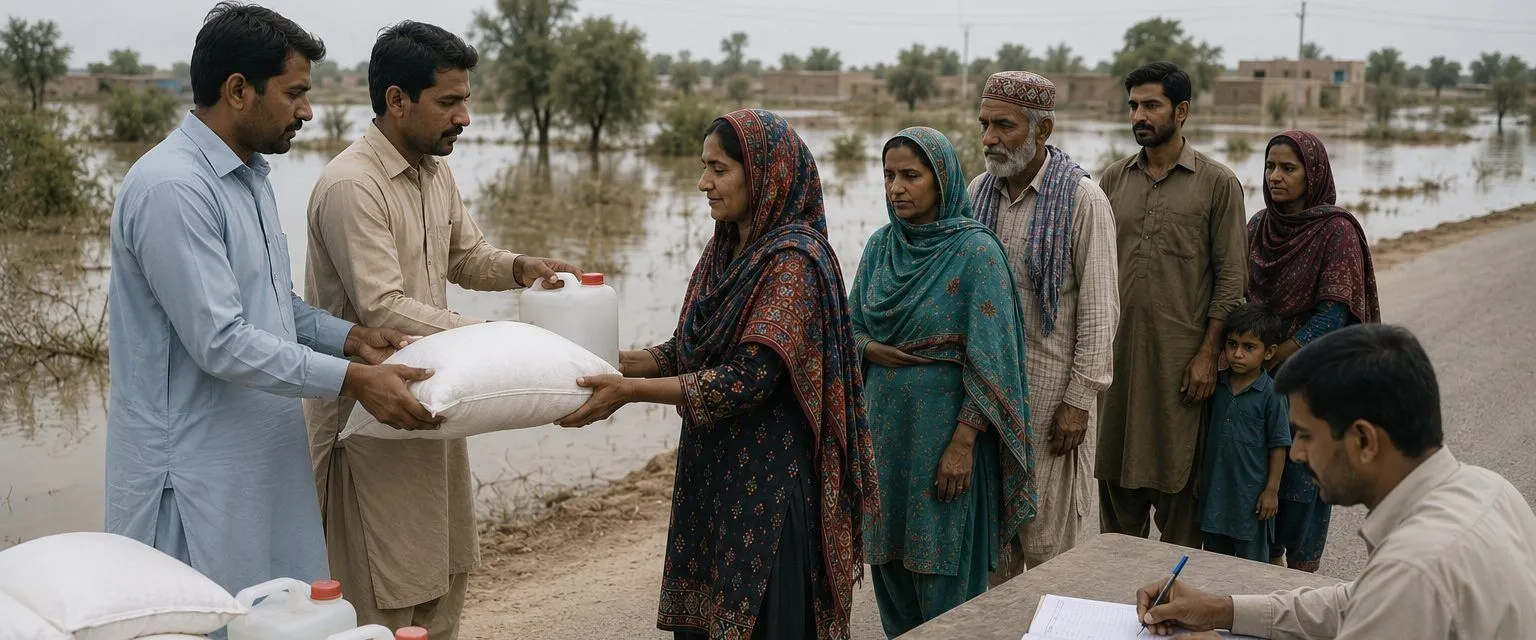
Sindh floods. It has flooded repeatedly within living memory, from riverine flooding along the Indus to the extraordinary monsoon rainfall that inundated large areas of the province in recent years, and the pattern of intense rainfall events appears to be intensifying rather than easing. For a household in a katcha area, near a canal, or in a low-lying part of a district such as Larkana, Dadu, Khairpur or Qambar Shahdadkot, preparedness is not pessimism. It is ordinary prudence, like keeping a spare tyre.
Most flood losses are not inevitable. Families who lose their documents, medicines, livestock and savings often lose them in the same avoidable ways. This is a practical household guide: what to do before the season, what to do when a warning comes, and what to watch for afterwards. National guidance and official alerts are published by the National Disaster Management Authority.
Before the season: the work that pays off
Protect your documents first
This is the highest-value preparation any household can make, and it costs almost nothing. Losing a CNIC, a land record or a B-Form does not merely inconvenience you; it can cut you out of compensation, relief registration, school admission and inheritance for years afterwards.
- Photograph every important document with a phone: CNIC for every adult, B-Form for every child, nikahnama, land records and fard, tenancy papers, school certificates, bank documents, vaccination cards, livestock papers.
- Send those photographs to a relative living outside the flood-prone area, and to your own email or cloud storage if you use one. Two copies in two places.
- Keep the originals together in a sealed plastic bag or box, inside a bag you can pick up in one movement.
- Register your CNIC address correctly, and ensure every adult in the household actually has a CNIC, which is issued through NADRA. Women without a CNIC are systematically excluded from relief and compensation, and the time to fix that is now, not during a crisis.
- Note down the mobile numbers of relatives and neighbours on paper. Phones are lost and batteries die.
Prepare a go-bag
One bag per household that can be carried by one person, kept somewhere everyone knows, checked before each monsoon:
- Documents in waterproof wrapping
- Cash in small denominations, since change is unavailable in a crisis
- Regular medicines with at least two weeks’ supply, particularly for blood pressure, diabetes, epilepsy, tuberculosis and heart conditions
- Oral rehydration salts, paracetamol, antiseptic, bandages, and any water purification tablets you can obtain
- Torch and spare batteries, and a power bank kept charged
- Matches or a lighter in a sealed bag
- Drinking water, and a clean container with a lid for carrying more
- Dry food that needs no cooking: dates, gur, dry roti, sattu, biscuits
- A change of clothes, chadar or dupatta, and something warm for night
- Soap, and sanitary supplies for the women and girls in the household, which relief distributions routinely under-provide
- A rope, a plastic sheet or tarpaulin, and a whistle
- Mosquito net, which becomes important very quickly after water recedes
Prepare the house and the plot
- Raise the plinth where you can, even by a few inches, when repairing or rebuilding. Small elevation gains prevent large losses.
- Build a raised platform or shelf inside the house for grain, seed, bedding and the flour stock.
- Clear the drainage channels around your house and street before the monsoon rather than during it.
- Identify the nearest high ground now: an embankment, a raised road, a school building, a shrine. Know how long it takes to walk there with children and elderly relatives.
- Agree a family meeting point in case you become separated, and make sure children know it.
- Know who in your street will need help to move: elderly people, pregnant women, people with disabilities, households headed by women alone.
Protect food, seed and savings
Store grain and seed above expected water level in sealed containers. Seed stock in particular determines whether the next season is possible at all. Avoid keeping all household savings as cash in the house, and where possible use a bank or mobile wallet account, which also makes receiving relief payments easier.
Livestock
For many households livestock is the largest asset, and losing animals converts a difficult year into a ruinous decade. Yet livestock is regularly overlooked in preparedness planning.
- Identify in advance where animals will be moved, generally a raised embankment or bund, and know the route.
- Keep animal vaccinations current before the season. Disease outbreaks after floods kill animals that survived the water.
- Store fodder above expected water level. Fodder shortage after a flood is severe and prolonged.
- Mark your animals so they can be identified after they scatter.
- Move animals early. Families who wait until water arrives frequently lose both the animals and, attempting to save them, sometimes a person.
- Do not send children to move livestock through moving water.
When a warning comes
Pakistan’s meteorological department, which publishes forecasts and flood bulletins, and provincial disaster management authorities issue warnings, and local administration and radio often carry them. Treat a warning as a signal to act, not to wait for more information.
- Charge every phone and power bank immediately.
- Fill every clean container with drinking water while the supply is still uncontaminated.
- Move documents, medicines and the go-bag to the ready position.
- Move livestock and fodder.
- Lift belongings onto raised platforms.
- Switch off the electricity supply to the house before water arrives, and disconnect any pump.
- Tell relatives outside the area where you intend to go.
- Leave early if the warning is serious. The single most dangerous decision families make is waiting until the water is visible.
Moving through water
Moving water is far stronger than it looks. Knee-deep flowing water can knock an adult down, and vehicles are swept away in less depth than most people assume. Do not attempt to cross a flooded road or channel where you cannot see the bottom. Use a stick to test the ground ahead, since roads collapse and covers wash away. Do not walk through floodwater at night if it can be avoided. Assume all floodwater is contaminated with sewage and, in Sindh, that it may contain snakes.
After the water
The period after a flood is when most illness and much of the long-term damage occurs.
Water and disease
Assume every water source is contaminated until proven otherwise. Wells, hand pumps and tanks that have been submerged are unsafe even once the water has cleared. Boil drinking water for at least one minute at a rolling boil, or treat it with chlorine, and store it in a covered container drawn from with a ladle rather than a hand. Our guide to treating drinking water at home covers dosing and storage in more detail.
The illnesses that follow flooding in Sindh are predictable: acute watery diarrhoea and cholera, typhoid, hepatitis A and E, skin infections, eye infections, and a sharp rise in malaria and dengue as standing water breeds mosquitoes several weeks later. Hepatitis E is particularly dangerous in pregnancy, which makes clean water for pregnant women a priority rather than a preference. This is also the list that a medical camp held after a flood tends to be built around.
Warning signs that require immediate care rather than home treatment:
- In a child: sunken eyes, no tears, no urine for many hours, lethargy or difficulty waking, inability to drink
- Blood in the stool
- Continuous vomiting preventing any fluid intake
- High fever persisting beyond two or three days
- Yellowing of the eyes or skin
- Any fever in a pregnant woman
- A wound that becomes red, swollen, hot or begins discharging
Keep oral rehydration salts prepared and given early. Most deaths from diarrhoeal disease are deaths from dehydration, and dehydration is treatable at home if treatment starts promptly. Continue feeding children, and continue breastfeeding infants throughout illness.
Returning home safely
- Inspect walls and roof before sleeping inside. Mud structures weaken invisibly after prolonged saturation and collapse after the danger appears to have passed.
- Do not restore electricity until wiring has dried and been checked.
- Watch for snakes and scorpions displaced into houses and stored materials.
- Discard food that has touched floodwater, including sealed items whose packaging is damaged, and any grain that has become wet.
- Drain standing water around the house, and cover or empty containers to reduce mosquito breeding.
- Use mosquito nets from the first night.
Documents, claims and children
Report and replace lost CNICs and B-Forms early, because relief registration and compensation processes depend on them. Photograph damage to your house, land and crops before repairing anything. Keep any receipt or slip issued at a relief distribution. And return children to school as quickly as circumstances allow, since a flood that interrupts a year of schooling often ends it altogether, particularly for girls, whose schooling already faces additional barriers in Sindh.
Community-level preparation
Households can do a great deal, but some things only work at street or village level: agreeing an evacuation route, identifying vulnerable neighbours in advance, keeping a shared list of contact numbers, maintaining a boat or tractor trolley to move people, and clearing drainage before the rains. Villages that have discussed these questions before the water arrives lose far less than villages that improvise. The Provincial Disaster Management Authority for Sindh publishes district advisories worth following at village level.
Where PHWO fits
Peace and Humanity Welfare Organization is a welfare organisation serving families across Pakistan, with its registered office in Larkana, Sindh. Our focus in this area is on preparation rather than only relief: helping households secure documents and identity records, supporting community evacuation planning, and working on safe drinking water. That approach is described on our emergency relief and preparedness page, and anyone willing to help with it can join as a volunteer.
The simplest version
If you remember nothing else from this article: photograph your documents and send them to someone outside the district, keep two weeks of essential medicines in a bag you can grab, know where your high ground is, move livestock early, leave before the water arrives, and boil or chlorinate every drop you drink afterwards.