
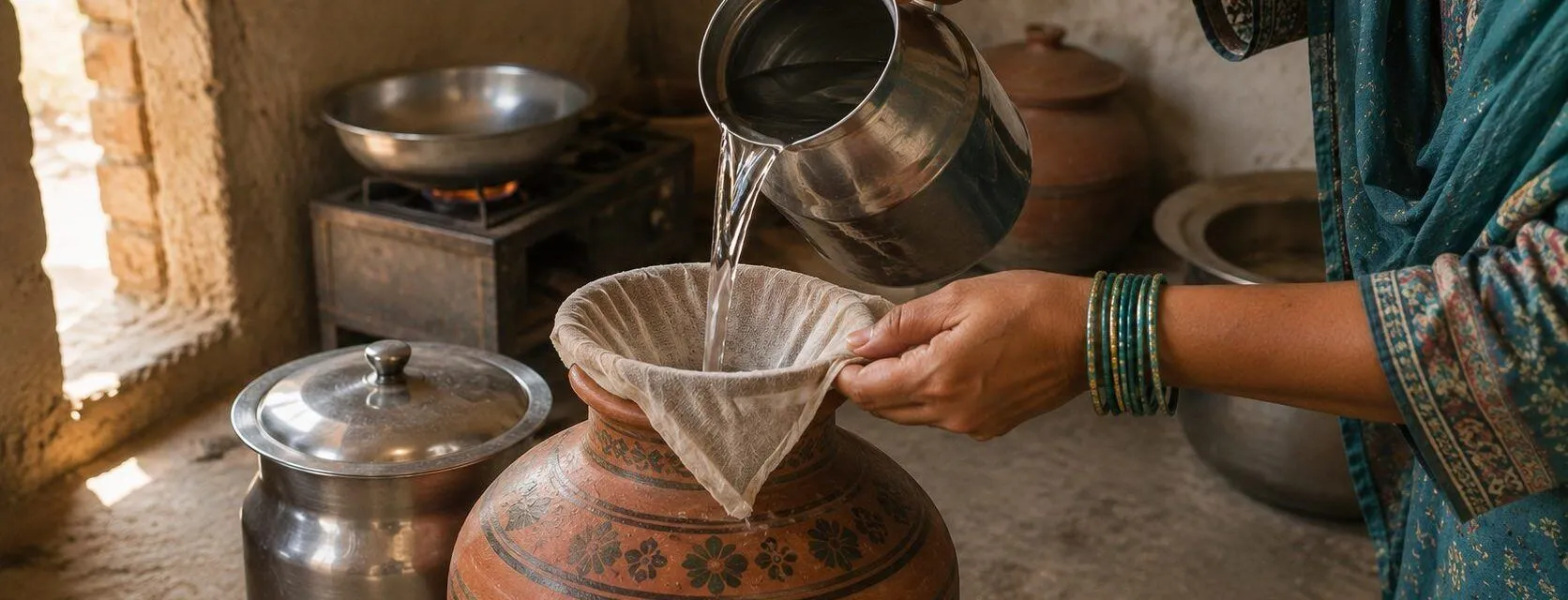
In much of interior Sindh, the water that arrives at a household is not safe to drink as it comes. Sources are contaminated by sewage, canal water is used directly for drinking in some areas, groundwater in parts of the province is brackish, and supply lines running alongside drains pick up whatever is in them. The result is a steady background of preventable illness, most of it in children.
The household-level fixes are old, well-understood and cheap. Boiling, chlorination, filtration and safe storage will remove or reduce most of the risk in most situations. This article explains how to do each properly, how to store water so you do not undo the work, and how to recognise waterborne illness early enough to act.
What is actually in unsafe water
It helps to distinguish two different problems, because they need different solutions.
Microbiological contamination means bacteria, viruses and parasites, almost always from human or animal faeces reaching the water. This causes diarrhoeal disease, cholera, typhoid, hepatitis A and E, dysentery and giardiasis. This is the dominant risk in Pakistan and it is the one that household treatment handles well. It rises sharply after flooding, which is why household flood preparation and water treatment belong together.
Chemical contamination means dissolved substances such as arsenic, fluoride, nitrates, or high salinity. These cause slow, cumulative harm rather than immediate illness. Crucially, boiling does not remove chemical contamination. Boiling arsenic-contaminated water concentrates the arsenic slightly as water evaporates. Chemical problems require a different response: an alternative source, or reverse osmosis filtration, or a treatment plant. If your area is known to have arsenic or high salinity, household boiling is not the answer to that particular problem. The World Health Organization country office for Pakistan publishes material on water quality and health here.
Clear water is not the same as safe water. Most dangerous contamination is invisible, and much of the water people trust because it looks clean is not.
Boiling: the most reliable method
Boiling kills bacteria, viruses and parasites. It is the most dependable household method available and requires nothing you do not already have. The World Health Organization publishes detailed drinking water quality guidance for households and providers.
- Bring the water to a rolling boil, meaning large bubbles breaking continuously across the surface, and hold it there for at least one minute.
- Longer boiling does not add meaningful safety and wastes fuel, which matters when fuel is bought.
- If the water is turbid, let it settle first and pour off the clear portion, or strain it through a clean folded cloth, before boiling.
- Allow it to cool covered, in the container you will store it in. Do not pour boiled water into a container that has held untreated water.
- Boiled water tastes flat. Pouring it between two clean containers a few times restores the taste by reintroducing air.
The practical limitation of boiling is fuel cost and time, particularly for a large household in summer. Many families boil the water intended for children and drinking, and use untreated water for washing, which is a reasonable compromise.
Chlorination: cheap, effective and often misunderstood
Chlorine kills bacteria and viruses reliably. Its weakness is that it is not effective against Cryptosporidium and is less effective against Giardia, which is one reason boiling remains the gold standard where fuel allows.
Doing it correctly
- Water purification tablets are the simplest option. Follow the dose printed on the packet for your container size, and wait the stated time, usually around thirty minutes, before drinking.
- Liquid chlorine solutions supplied for water treatment come with dosing instructions. Follow them rather than estimating.
- Household bleach can be used in an emergency, but only plain, unscented sodium hypochlorite with no added detergent, perfume or colour-safe additives. Concentration varies by product, so read the label and follow the dosing guidance on it or from a health worker.
- Wait after dosing. Contact time is what does the work. Drinking immediately after adding chlorine defeats the purpose.
- Turbid water needs clarifying first. Suspended particles shield microorganisms from chlorine. Settle and strain, or use a combined flocculant-disinfectant sachet where available.
- A faint chlorine smell is a sign it worked. No smell at all after the waiting period may mean the dose was insufficient or the chemical has lost strength. Chlorine products degrade with age and heat, so check dates and store them cool and dark.
Filtration
Filters vary enormously and the word covers very different products.
- Cloth straining removes visible particles and some larger organisms. It is a useful pre-treatment step and does not make water safe.
- Ceramic candle filters remove bacteria and particles effectively when the candle is intact and clean, but do not reliably remove viruses. Candles must be scrubbed and replaced on schedule; a neglected candle becomes a breeding surface and can make water worse.
- Activated carbon improves taste and odour and removes some organic chemicals. On its own it does not disinfect.
- Membrane filters, including hollow-fibre units and the water filter systems distributed by some programmes, remove bacteria and protozoa effectively and are well suited to household use if backwashed as instructed.
- Reverse osmosis addresses dissolved chemical contamination, salinity, arsenic and fluoride. It is more expensive, wastes a proportion of the water it treats, and requires maintenance and electricity, which in many villages means a solar system sized for the load, but in areas with chemically contaminated groundwater it may be the only real solution.
A general rule: filtration plus disinfection is stronger than either alone. Filter to remove particles and protozoa, then boil or chlorinate to deal with bacteria and viruses.
Safe storage: where most households lose the benefit
Water treated carefully and then stored badly is recontaminated within hours. This step is routinely neglected and it matters as much as the treatment itself.
- Store in a covered container. An open matka or bucket collects dust, insects and whatever falls in.
- Use a container with a narrow mouth and a tap if possible, so nothing is dipped into it.
- If you must dip, use a long-handled ladle kept only for that purpose. A single dirty cup contaminates the whole vessel.
- Wash storage containers regularly with soap, rinse well, and dry them in sunlight where possible.
- Do not top up. Empty, clean and refill rather than adding new water to old.
- Keep the container off the floor and out of reach of animals and small children.
- Never use containers that previously held pesticides or fuel, however well washed.
The rest of the chain
Water is one route among several. Handwashing with soap, particularly after using the toilet and before preparing food or feeding a child, interrupts transmission at least as effectively as water treatment does. So does safe disposal of faeces, including infant faeces, which are frequently treated as harmless and are not. So does keeping the area around a hand pump clean and drained, and animals and latrines away from it. Treating water while ignoring hygiene addresses half the problem.
Recognising waterborne illness early
The most important skill for a household is knowing when home care is enough and when it is not, and where the nearest care is, whether that is a health facility or a visiting medical camp.
Start oral rehydration immediately
Diarrhoea kills through dehydration, not through infection in most cases. Oral rehydration salts should be started at the first loose stool, not after the person weakens. One sachet in the volume of clean water stated on the packet, given in small frequent sips. Do not make it stronger than instructed. Where ORS is unavailable, a home solution of six level teaspoons of sugar and half a level teaspoon of salt in one litre of clean water can be used, but packaged ORS is preferable.
Zinc supplementation for children with diarrhoea, given for ten to fourteen days, is recommended and reduces both duration and severity. Continue feeding, and continue breastfeeding infants throughout. Withholding food during diarrhoea is a common practice and a harmful one. UNICEF Pakistan publishes guidance for families on managing childhood diarrhoea.
Signs requiring medical care without delay
- In a child: sunken eyes, no tears when crying, dry mouth, no urine for six to eight hours, unusual sleepiness or difficulty waking, or refusal or inability to drink
- Skin that stays pinched when released
- Blood in the stool
- Persistent vomiting preventing any fluid intake
- Fever lasting more than two or three days, which may indicate typhoid
- Yellowing of the eyes or skin, and dark urine, which suggest hepatitis
- Any of the above in a pregnant woman, an infant, or an elderly person, where deterioration is faster
Hepatitis E is particularly dangerous during pregnancy, which is a strong reason to ensure that pregnant women in a household drink treated water even when others do not.
A practical household routine
- Decide which source you will use for drinking, and keep it separate from washing water.
- Settle or strain it if it is cloudy.
- Boil it, or chlorinate it and wait the full contact time.
- Cool and store it, covered, in a cleaned narrow-mouthed container with a tap or a dedicated ladle.
- Wash the container properly every few days.
- Keep ORS sachets in the house and use them at the first sign of diarrhoea.
- Wash hands with soap at the moments that matter.
Where PHWO fits
Peace and Humanity Welfare Organization is a welfare organisation serving families across Pakistan, with its registered office in Larkana, Sindh. Our focus in this area is on household practice and hygiene education alongside any physical provision, because a filter installed without the storage and hygiene habits around it delivers far less than it promises. This sits alongside our wider healthcare plans, and readers who want to support that work can give towards it.
Finally
Safe drinking water at home is not complicated. It is a matter of consistency: treat it every time, store it covered, never dip a hand into it, wash hands with soap, and keep rehydration salts within reach. Done routinely, these habits prevent a large share of the illness that rural households in Sindh currently accept as normal.