
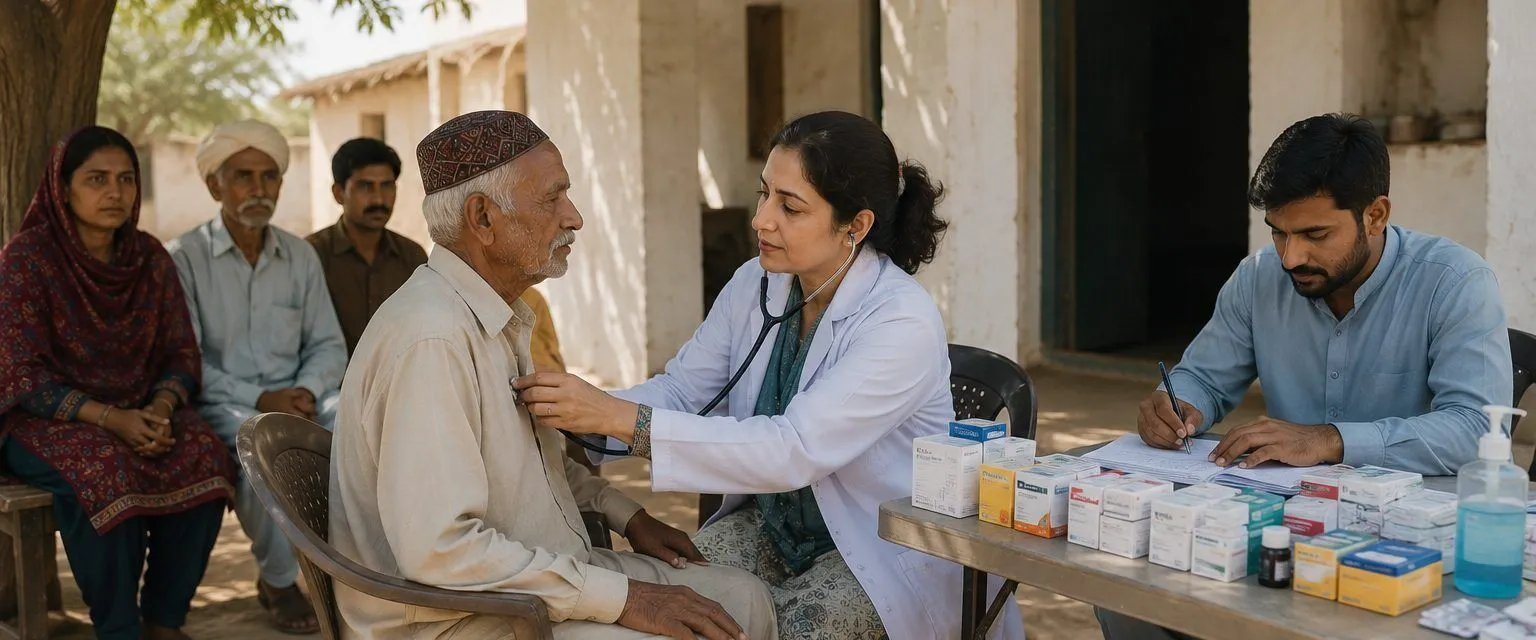
The free medical camp is one of the most recognisable forms of charitable work in Pakistan. A hall or school courtyard is arranged, doctors volunteer a day, a crowd arrives, hundreds of people are seen, medicines are handed out and photographs are taken. It is genuinely useful and it is also, quite often, less useful than it appears.
The difference between a camp that helps and a camp that merely happens comes down to a small number of unglamorous decisions: who you plan for, how you sort patients on arrival, what you do with the people you cannot treat, what medicines you bring, and whether anyone ever follows up. This article sets out what a well-run camp actually involves, for organisations planning one and for donors deciding whether to fund one.
Be honest about what a camp can and cannot do
A one-day camp is good at a specific set of things:
- Detecting conditions people did not know they had, particularly raised blood pressure and diabetes
- Treating acute, self-limiting illness: skin infections, respiratory infections, diarrhoeal illness, minor injuries
- Deworming and basic nutritional screening in children
- Antenatal screening and identifying high-risk pregnancies
- Eye screening, particularly cataract identification and refraction
- Health education delivered to a captive and attentive audience
- Reaching people who would otherwise never present to any facility
It is bad at:
- Managing chronic disease, which by definition requires continuity
- Anything needing investigation, imaging or surgery
- Complex diagnosis in a five-minute consultation without records
- Mental health, which cannot responsibly be opened and abandoned in one sitting
Most of the disappointment around camps comes from expecting the second list. A camp is a screening and triage event with some treatment attached. Designed as that, it works. Marketed as a hospital for a day, it does not.
Planning: the four weeks before
Choose the site with the community, not for it
The location should be decided in conversation with local people: a village elder, a school head, a lady health worker, an imam, a union council representative. They know which settlement is genuinely underserved, which day of the week people are free, and which venue women will actually enter. A camp held on market day, or in a building women cannot comfortably use, will see the wrong patients.
Establish the referral pathway first
This is the single most important preparation step and the one most often skipped. Before the camp is announced, you should be able to answer: where does a patient with a suspicious lump go? Where does a woman with a high-risk pregnancy go? Who pays for it? Who takes her there?
That means contacting the nearest secondary hospital, the district headquarters hospital, an eye hospital, a tuberculosis programme centre, and any charitable hospital within reach, and agreeing in advance how referred patients will be received. The WHO country office for Pakistan is a useful starting point for understanding how the public system is structured. Without this, screening becomes a way of informing people they are ill and leaving them there.
Match the team to the expected patients
The commonest need at rural camps is general medicine, paediatrics and women’s health. A camp with six general physicians and no female doctor will turn away half the population, because many women will not be examined by a male clinician. At minimum plan for a female doctor or, failing that, a female health worker and a screened private examination area.
Also plan for the unglamorous roles: a registration clerk, a triage nurse, a pharmacy dispenser, volunteers managing the crowd, and someone whose only job is directing people. Camps fail on queue management far more often than on clinical skill.
Bring the right medicines, in the right form
A small, well-chosen formulary beats a large donated one. Base it on the national essential medicines list, for which the World Health Organization publishes the model guidance, and on what you actually expect to see: oral rehydration salts, zinc, paracetamol, common antibiotics, antihistamines, antifungal and antiscabetic preparations, iron and folic acid, deworming tablets, basic antihypertensives, and simple eye and skin preparations.
Practical rules that matter:
- Check expiry dates on everything, including donations. Distributing near-expiry medicine is not charity.
- Never accept or hand out unlabelled or repackaged loose medicine.
- Dispense a meaningful course, not three tablets. A partial antibiotic course is worse than none, because it contributes to resistance without curing the patient.
- Label in Sindhi or Urdu, and explain verbally. Assume the patient may not read.
- Maintain cold chain if any item requires it, or do not carry that item.
- Keep a dispensing register. It is your audit trail and your stock control.
On the day: flow and triage
A camp that sees 400 people badly is worse than one that sees 150 people properly. Design the flow deliberately.
- Registration. Name, age, sex, village, contact number where available, and a unique token. The contact number is what makes follow-up possible later, so collect it properly.
- Vitals and triage. Blood pressure, weight, temperature, blood glucose where indicated, and mid-upper arm circumference for children. This station identifies who must be seen urgently and catches the asymptomatic hypertension and diabetes that are the camp’s highest-value findings.
- Consultation. Separate queues for men, women and children where numbers allow. Screened space for women. A realistic consultation length, which means capping the number of tokens issued rather than pushing everyone through.
- Referral desk. A named station, not an afterthought. Patients needing onward care get a written referral slip, the name of a contact person at the receiving facility, and their details recorded for follow-up.
- Pharmacy. Dispensing with verbal explanation and, where useful, a pictorial dosage marking on the packet.
- Health education corner. While people wait. Hand hygiene, treating drinking water at home, oral rehydration preparation, breastfeeding, immunisation, and warning signs in pregnancy. This is free teaching time with an audience that has nothing else to do.
Consent, dignity and safeguarding
Basic standards are not optional because the service is free. Explain what you are doing before you do it. Do not photograph patients without informed permission, and never photograph a patient mid-examination or a child alone. Keep registration data secure rather than in an open notebook on a public table. Ensure no unaccompanied child is examined without a guardian or a designated female staff member present. A camp is a temporary clinic, and the ethics of a clinic apply to it.
Why one-off camps without referral do limited good
Consider a typical outcome. A camp screens 300 people and finds 40 with raised blood pressure, 15 with probable diabetes, 6 women with high-risk pregnancies and 3 with findings suspicious for cancer. Each receives a diagnosis and, in the case of the hypertensive patients, perhaps one month of tablets.
What happens next? The hypertensive patients finish the month and stop, because nobody has told them where to obtain more, and many will conclude the tablets were a cure. The diabetic patients have no glucometer and no dietary support. The pregnant women have a piece of paper and no transport money. The three with suspicious findings have been given fear without a route to resolution.
The camp will still report 300 patients treated. In practice its lasting benefit is confined to the acute infections it cured and the health education it delivered. This is the central weakness of the format, and it is fixable, but only by design rather than by good intentions.
What turns a camp into something durable
- Return to the same place. A quarterly camp in one village beats four camps in four villages. Continuity is the entire point.
- Link to what already exists. The lady health worker, the basic health unit, the vaccinator. These people are permanent and you are not. Strengthen them rather than bypassing them.
- Fund the referral, not just the camp. Transport and treatment costs for referred patients are the highest-return money in the entire budget and almost nobody budgets for them.
- Follow up by phone. A volunteer calling referred patients two weeks later, asking whether they went and helping if they did not, converts screening into care at negligible cost.
- Measure the right thing. Not patients seen. Referrals completed, chronic patients still on treatment at three months, children whose immunisation was brought up to date, a measure UNICEF Pakistan reports on in its own programme pages.
Where PHWO fits
Peace and Humanity Welfare Organization is a welfare organisation serving families across Pakistan, with its registered office in Larkana, Sindh. Our healthcare programme is designed to build every camp around the referral pathway before anything else, to return to the same community rather than moving on, and to report outcomes for referred patients rather than attendance figures alone. If that means a smaller camp, we accept that, and anyone who wishes to contribute towards it can see exactly how funds are handled first.
For donors
If you are asked to fund a medical camp, three questions will tell you most of what you need to know. Where do referred patients go, and who arranged it? Will you return to this community, and when? What will you count as success? An organisation with clear answers is doing the work. An organisation that answers with attendance numbers and photographs is doing an event. The same instinct applies to judging any charity before you fund it.