
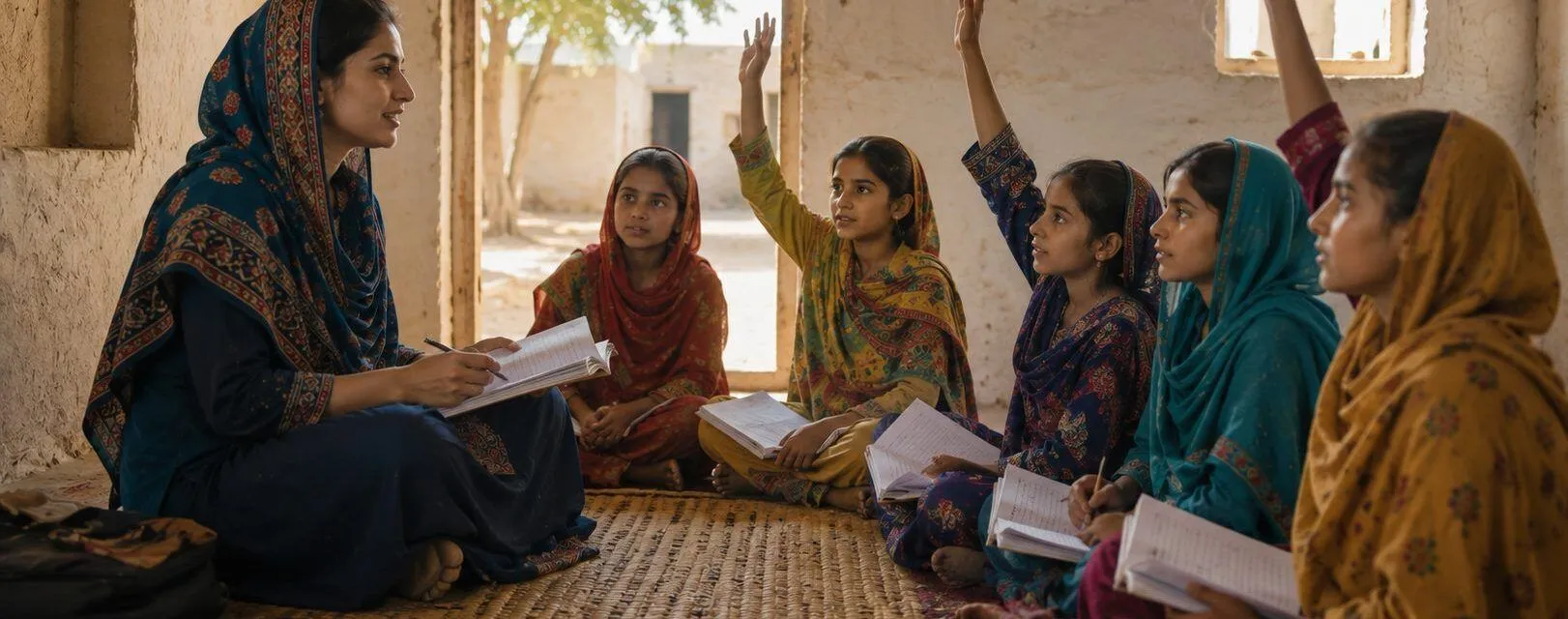
Ask almost any family in rural Sindh whether they want their daughters educated and the answer is yes. This is worth stating plainly, because the popular explanation for low female enrolment tends to begin and end with “attitudes”, which is both inaccurate and unhelpful. Attitudes exist and matter, but they are usually downstream of practical conditions. Change the conditions and behaviour changes surprisingly quickly.
Household surveys and education assessments in Pakistan have consistently shown the same shape of problem: enrolment for girls is lowest in rural areas, drops sharply after primary level, and falls fastest where the nearest school is furthest away. The Pakistan Bureau of Statistics publishes the household survey data behind such findings. Understanding why, in specific and unromantic terms, is the first step towards doing anything useful about it.
Barrier one: distance, and what distance actually means
In many villages a primary school exists within walking distance. A middle or high school for girls may not. When the nearest option is several kilometres away, the family faces a genuine calculation involving an adolescent daughter walking or travelling alone, on rural roads, sometimes past areas the family considers unsafe, twice a day.
This is rarely irrational. It is a risk assessment. And it explains why the drop-off is so sharp precisely at the transition from primary to middle school, which is also the age at which families become more protective.
Where transport has been provided, or where a school has been sited within the village rather than at a convenient administrative point between villages, enrolment responds. Distance is one of the few barriers where the mechanism is unambiguous.
Barrier two: no functioning toilet
A school without a working, private, lockable toilet with water is not a school an adolescent girl can attend for the whole month. This single physical fact removes girls from classrooms more efficiently than almost any belief.
The problem is often not the absence of a structure but the absence of maintenance: no water connection, a broken door, no lock, no cleaning arrangement, or the facility repurposed for storage. A toilet that exists on paper and not in practice produces exactly the same absence.
Access to safe water, at school as much as at home, sits underneath this. Menstrual hygiene management is the underlying issue and it is not adequately addressed by construction alone. It needs water, privacy, disposal, and a female staff member the girls can speak to without embarrassment. Where those four things are present, monthly absence falls; where any one is missing, girls miss several days each month, fall behind, and eventually stop coming.
Barrier three: the absence of female teachers
Many families will send a daughter to a school with a female teacher and will not send her to one staffed entirely by men, particularly beyond the earliest classes. This is a well-recognised pattern across rural Pakistan.
The difficulty is circular. Female teachers are scarce in rural areas partly because educated women are scarce in rural areas, and educated women are scarce because girls did not complete school. The Sindh school education department is where recruitment rules and school-level information are published. Breaking the loop requires recruiting and retaining teachers locally, which in turn requires accommodation, safe transport, salary paid on time, and posting near a woman’s own community rather than at a distance that her family will not accept.
It is worth noting that teacher absence, not just teacher shortage, is part of the picture. A school with an assigned teacher who rarely appears teaches families that education is not serious, and that lesson is learned quickly.
Barrier four: cost, even when school is free
Government schooling is nominally free. The actual cost to a household is not zero:
- Uniforms and shoes, replaced as a child grows
- Notebooks, stationery and examination fees
- Transport, where the school is not walkable
- Informal charges at school level
- The value of the girl’s labour at home: younger siblings cared for, water fetched, livestock tended, crops harvested at peak season
That last item is the largest and the least visible. For a household living close to the margin, an older daughter’s time has real economic value. Education competes with it. This is why seasonal attendance patterns follow the agricultural calendar and why targeted support, whether a stipend, a uniform, or a reliable school meal, can shift decisions that appear cultural but are actually financial.
Barrier five: early marriage
Early marriage and school dropout are tangled together, and the direction of causation runs both ways. A girl who has left school is more likely to be married early; a girl expected to marry early is less likely to be kept in school. Sindh has legislated on the minimum age of marriage, and law matters, but law alone changes little where the alternative to marriage is an idle year at home.
The practical lever is not exhortation. It is making continued education visible, available and worth something. Where a girl can plausibly see herself becoming a teacher, a lady health worker, a tailor with her own customers or a remote worker earning from home, families reconsider timing. Where there is no visible path beyond matriculation, arguments about the harms of early marriage carry little weight.
Barrier six: what happens inside the classroom
Enrolment is not the same as learning. Learning assessments across Pakistan have repeatedly found that a substantial share of children in the middle primary years cannot read a simple story or do basic arithmetic, a pattern UNICEF’s Pakistan country pages discuss alongside out-of-school children. A child who cannot follow the lesson does not stay in the room for long, and parents who see no progress lose their reason to bear the costs.
Contributing factors include overcrowded multi-grade classrooms, instruction in a language that is not the child’s home language, teaching that relies on memorisation, and a curriculum that moves on regardless of whether the class has understood. None of these are solved by building more classrooms.
What actually works
The evidence base from Pakistan and comparable contexts points repeatedly to a small number of measures. None are novel; they are simply unglamorous.
- Put the school where the girls are. Reducing distance, particularly for middle and secondary level, produces some of the largest observed gains. Where a new school is not possible, safe organised transport is the next best thing.
- Fix and maintain toilets and water. Not construct: maintain. A maintenance budget and an accountable person matter more than the initial build.
- Recruit female teachers locally and support them properly. Local recruitment, timely salary, accommodation where needed, and professional development. Retention is the goal, not just appointment.
- Reduce the household cost. Stipends conditional on attendance, uniforms, stationery, or school meals. Modest, predictable support changes marginal decisions.
- Work with parents and community leaders rather than around them. School management committees that genuinely include mothers, and conversations with elders and religious leaders, tend to produce durable change. Programmes that treat families as obstacles rarely last past their funding.
- Teach at the right level. Grouping children by actual competence rather than nominal grade, particularly for foundational reading and arithmetic, has a strong record. Learning keeps children in school better than persuasion does.
- Make the destination visible. Older girls who have continued studying or are earning, brought back to speak to younger ones, do more than any poster campaign.
- Track individual children, not totals. Knowing that Zainab has missed eleven days and following up with her family is the work. Aggregate enrolment figures conceal exactly the children who are about to be lost.
What does not work
It is equally useful to name the approaches that consume resources and produce little: one-off awareness campaigns with no follow-up; buildings constructed without staff, water or maintenance; distributions of bags and books photographed and never repeated, which is the clearest example of effort that looks like help without being it; and programmes designed entirely in a city office without a single conversation in the village where they will run. These are not harmless. They spend goodwill that the next organisation will need.
Where PHWO fits
Peace and Humanity Welfare Organization is a welfare organisation serving families across Pakistan, with its registered office in Larkana, Sindh. Our education programme is designed to begin with the least visible and most decisive constraints rather than the most photogenic ones: functioning toilets and water in schools that already exist, support for girls at the primary-to-middle transition, and work alongside school management committees rather than parallel to them. We would rather do one thing that holds than several that do not. Teachers and organisers in the district are welcome to put their names forward.
A closing thought
Families in rural Sindh are making reasonable decisions under difficult constraints. Treating them as the problem guarantees failure. Removing the constraints, one specific and boring obstacle at a time, is slower to describe and far more likely to work.