
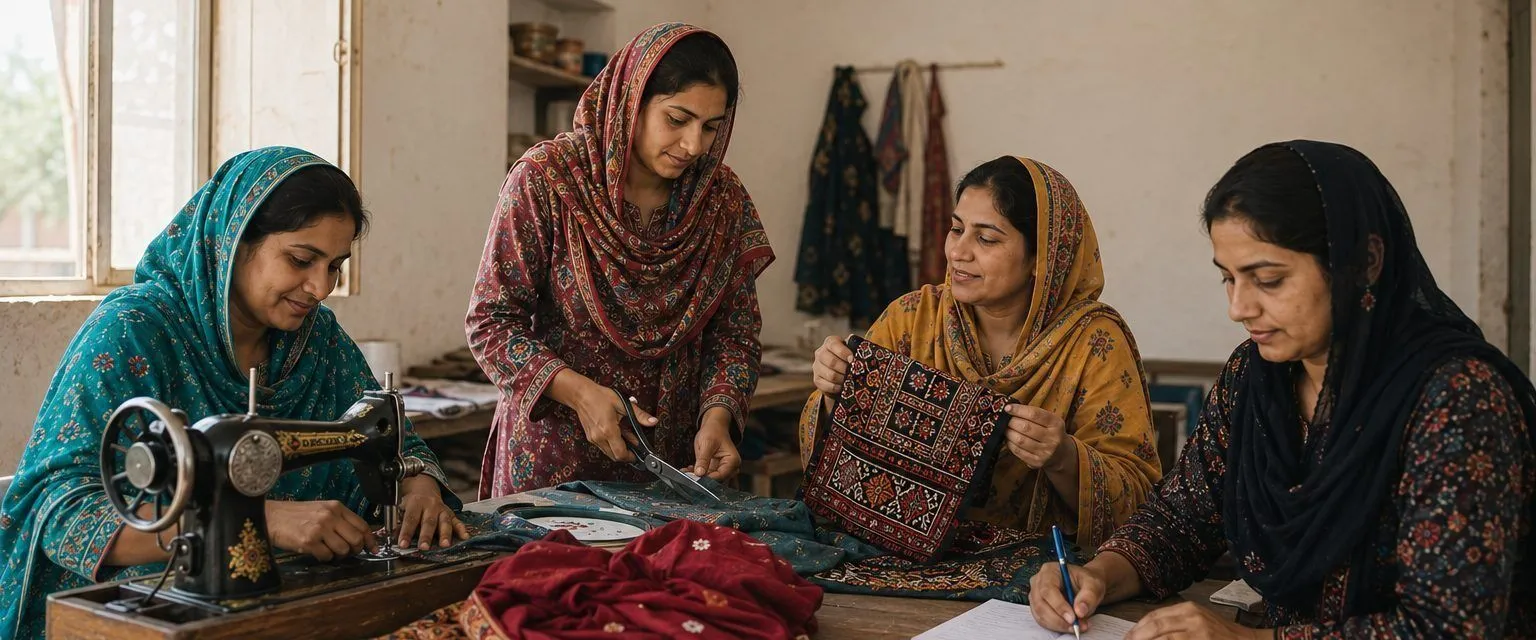
There is a familiar sequence in development work. A vocational training centre opens, thirty women attend a three-month tailoring course, certificates are distributed at a closing ceremony, and the project reports thirty women trained. A year later, perhaps three of them are earning anything from it.
This is not because the women were incapable or unmotivated. It is because training and livelihood are different things, and the gap between them is where most such programmes quietly fail. This article looks at which vocational routes genuinely produce income for women in interior Sindh, and at what has to exist alongside the training for income to actually appear.
The gap between training and livelihood
A woman who has learned to sew still needs, at minimum: a machine she controls, a place to work, raw material, customers, the ability to price her work, a way to be paid, and household agreement that her time may be spent this way. Training supplies one item on that list.
The missing pieces tend to be specific and solvable:
- Equipment. Without her own machine, a trained tailor is dependent on someone else’s. Many programmes now pair training with a machine, and the difference in outcomes is stark.
- Working capital. Cloth, thread, feed, cosmetics, packaging. A woman with no cash to buy inputs cannot start, no matter how skilled.
- Market access. This is the single most common failure. Thirty women trained in the same skill in the same village now compete with one another for the same small local demand. Someone has to open a route to buyers outside the village.
- Pricing and basic numeracy. Many home producers price below their own cost because they do not count their material accurately and do not count their time at all.
- Control over earnings. If income is handed over immediately and she has no say in it, motivation collapses. A bank or mobile wallet account in her own name is not a technicality.
- Household negotiation. Programmes that engage husbands, fathers and mothers-in-law from the start have far higher completion and continuation rates than those that treat the family as an obstacle.
- Mobility. If she cannot travel to a market, the market has to come to her, through an aggregator, a collection point or an online channel, which is where basic digital skills begin to matter.
A programme that addresses these is a livelihoods programme. A programme that only teaches the skill is a course.
Routes that genuinely produce income
Tailoring and stitching
The most common route, and it works, but only past a certain level of skill. Basic shalwar kameez stitching is a saturated market in most villages, and rates are correspondingly low. The women who earn meaningfully are those who can do something the neighbours cannot: bridal and formal wear, children’s clothing at volume, alterations done to a fine finish, school uniforms in bulk, or specialist finishing such as piping, pico and lining.
Practical implications: train longer and to a higher standard rather than broader; teach measurement and pattern cutting properly rather than copying an existing garment; and treat a bulk order from a school, a uniform supplier or a small boutique as the actual objective, since a single institutional contract is worth more than fifty walk-in customers.
Embroidery, ajrak and traditional craft
Sindh’s craft traditions, including ajrak, ralli quilting, Sindhi hand embroidery, mirror work and applique, have real market value in Karachi, Lahore, Islamabad and among the diaspora. The skill in many villages is already excellent. The constraint is almost never craftsmanship.
The constraints are design direction, consistency and price realisation. Urban buyers want particular colourways, sizes and finishes, delivered to a repeatable standard, on time. And the value chain is long: a piece that sells for several thousand rupees in a city boutique may have earned the maker a small fraction of that.
What changes outcomes here is aggregation and direct market linkage: a producer group that can accept a bulk order, agree quality standards, and sell directly to a retailer or online rather than through several intermediaries. Costing the artisan’s hours honestly is central. Many craft interventions unintentionally institutionalise underpayment by pricing from what the market currently pays rather than from what the work costs.
Poultry keeping
Backyard poultry is one of the most reliable small enterprises for rural women in Sindh. It works because it is compatible with household routines, requires no travel, produces both eggs for the household and a saleable surplus, and starts small.
It fails when treated as a one-off distribution of birds. The determinants of success are vaccination, particularly against Newcastle disease, secure night housing against predators and theft, clean water, adequate feed, and access to someone who can advise when birds fall ill. A distribution of chicks without vaccination and follow-up frequently ends with most birds dead within months, and the woman poorer in confidence than before.
Small ruminants, goats in particular, follow a similar logic with a longer cycle and a higher unit value.
Kitchen gardening and food processing
Modest in scale but genuinely useful. A household vegetable plot reduces expenditure, which functions as income, and improves diet. Beyond that, processing adds value: pickles, chutneys, dried vegetables, spice blending and packaging. Food handling hygiene and honest labelling matter, and packaging quality often determines whether a product can be sold beyond the immediate neighbourhood.
Beautician and salon skills
Frequently dismissed and frequently among the most profitable options available to women in small towns. Demand is concentrated around weddings and Eid, income can be substantial in season, the work is socially acceptable because it is women serving women, and it can begin at home with modest equipment.
The determinants are the quality of training, particularly in bridal makeup and hair, hygiene and safety standards, and building a local reputation. A woman working from home in a small town such as Larkana, Ratodero or Shikarpur with genuine bridal skill can earn more than most other options on this list.
Digital and remote work from home
This is the route with the highest ceiling and the highest failure rate, and both facts deserve honesty. The learning material itself can be obtained free, since freeCodeCamp publishes complete self-paced courses at no charge.
It suits women who have completed secondary education or beyond, have reasonable literacy in Urdu and preferably English, and have household support for spending hours at a computer. For a woman whose mobility is restricted, it is one of the few options that removes the mobility constraint entirely rather than working around it.
Realistic entry points are graphic design, social media content creation and management, data entry and bookkeeping, virtual assistance, transcription, and online tutoring, which is particularly well suited to women who have completed education and can teach school subjects or Qur’an to students elsewhere. Our guide to freelancing from Larkana goes into each of these.
The honest caveats: it requires a computer, not only a phone, for most work; a reliable connection and a plan for load shedding; three to six months of consistent practice before the skill is saleable; and a functioning payment route, which in Pakistan generally means a cross-border payment service such as Payoneer or a bank account, with the account in her own name and matching her CNIC. Programmes that promise quick income from digital work are, without exception, misleading people.
What a livelihoods programme should include
- Market assessment before curriculum design. Ask who is buying, at what price, in what quantity, before deciding what to teach. Training thirty women for a market that absorbs five is a predictable failure.
- Fewer skills, taught to a higher standard. Employability begins above a threshold of competence, not below it.
- A starter asset or a route to one. Machine, birds, tool kit, or a small revolving fund.
- Financial literacy that is actually used. Costing a product including her own time, keeping a simple record, separating business money from household money.
- An account in her own name, with the CNIC issue resolved first if necessary, which begins at a NADRA registration centre. Women without a CNIC cannot open accounts, register a SIM, or access government support, and helping with that alone changes lives.
- Producer groups. Collective buying reduces input costs and collective selling makes bulk orders possible.
- Household engagement from day one.
- Follow-up at six and twelve months, measuring income earned rather than certificates issued.
Measuring the right thing
The standard indicator, women trained, is the wrong one. It measures activity, not result. More honest indicators are: how many are still practising the skill after twelve months; how much they earned in the last three months; whether they control that income; whether they sold outside their own village; and whether they have repeat customers.
These numbers are smaller and less impressive in a report. They are also the only ones that correspond to anything real.
Where PHWO fits
Peace and Humanity Welfare Organization is a welfare organisation serving families across Pakistan, with its registered office in Larkana, Sindh. Our programme is designed to begin with a market assessment rather than a curriculum, to run fewer and longer courses instead of many short ones, to pair training with a starter asset and a bank account in the woman’s own name, and to report twelve-month income rather than attendance. If that means training twenty women well instead of two hundred briefly, we consider that the correct trade. Our women’s empowerment plans and how to offer your time are set out elsewhere on the site.
In closing
Women in interior Sindh are not short of capability, and in the case of craft, they are not short of skill either. What is usually missing is equipment, working capital, a buyer beyond the village, control of the resulting money, and someone still present twelve months later. Any programme that supplies those alongside the training will outperform one that supplies certificates.